About 47 minutes
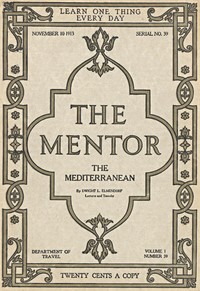
The Mentor: The Mediterranean, Vol. 1, Num. 39, Serial No. 39, November 10, 1913 — Reading Companion
Travel Narratives
10,664 recorded words. 5 minutes difference from this book's estimate.
View Gutenberg source #49816
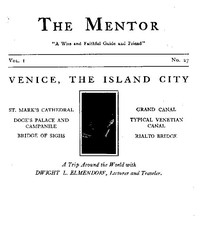
The source record for The Mentor: Venice, the Island City, Vol. 1, Num. 27, Serial No. 27 — Reading Companion measures this digital text at 9,518 words, 42 min estimated reading time, and 7 detected text sections.
The text analysis averages about 18.5 words per sentence, while the detected sections provide another way to judge how the source is divided.
Project Gutenberg metadata also associates the work with “Venice (Italy) -- Description and travel,” connecting these edition facts with the source record’s subject description.
Explore this collection
These alternatives are selected using recorded categories and estimated reading time.
About 47 minutes
Travel Narratives
10,664 recorded words. 5 minutes difference from this book's estimate.
View Gutenberg source #49816About 63 minutes
Travel Narratives
14,327 recorded words. 21 minutes difference from this book's estimate.
View Gutenberg source #49453About 205 minutes
Travel Narratives
47,063 recorded words. 163 minutes difference from this book's estimate.
View Gutenberg source #49043Search stored excerpts and compare books → Choose by your preferences →
Choices use stored catalog measurements. Estimates vary with reading speed. A shared category is a catalog label, not a claim that two books have the same argument or literary quality.
Search reads excerpt text stored with this catalog and links to its associated Gutenberg record. The connection is stored in the site database; this tool does not recheck that every excerpt is word-for-word identical to that external record. Excerpt search does not cover every chapter and does not verify historical publication dates.
Catalog snapshot checked: 2026-09-26. Coverage: 100 public books, 100 available source excerpts.
Calculated from edition completeness, EPUB availability, text structure and catalogue metadata. Not a user rating.
Total of 100 points, scaled to a 2.5-5.0 range. Editions with an empty description or a missing EPUB file are not scored.
Public-domain source text
The source text is kept in the dedicated reader, separate from this catalogue record and its commentary.
Dwight L. Elmendorf's 1913 issue of The Mentor introduces Venice not as a museum but as a living city shaped by its lagoon setting. The opening pages immediately establish the city's physical uniqueness: built on 117 islands, connected by 150 canals and 378 bridges, with foundations of petrified piles driven into layers of clay, sand, and peat. Elmendorf's voice is that of an informed lecturer, addressing the reader directly—"Let us step into a gondola"—and guiding a tour up the Grand Canal. The text is punctuated by literary quotations, including a lengthy passage from Charles Dickens describing the Bridge of Sighs and the prisons of the Doge's Palace, which shifts the tone from picturesque travelogue to historical grimness.
The catalog subject "Description and travel" is borne out by Elmendorf's focus on Venice's material reality. He details the depth of artesian wells (1,600 feet) and the succession of clay, sand, and peat beds beneath the city. The claim that piles become petrified in the anaerobic mud is presented as fact, lending a scientific air to the description. The text also notes the absence of sidewalks: "in many places the water laps the very walls of the buildings," forcing residents to live "on either stone or water." This concrete detail—that some inhabitants have never seen a grove or country lane—grounds the romantic image of Venice in a specific, almost alien, urban geography.
Elmendorf's narrative device is a virtual boat ride, moving from the Dogana di Mare (built 1676 by Benoni) to the railway station and back. He names palaces in sequence: Palazza Genovese (1898), Rezzonico (home of Robert Browning), Ca' d'Oro (once gilded), and the Fondaco dei Tedeschi (German merchants' guild from the 13th century). The tour is a catalog of architectural styles—Byzantine, Gothic, Byzantine-Romanesque—and historical anecdotes, such as the plague vow that led to Santa Maria della Salute. The Rialto Bridge area is called "the Wall Street of Venice," a simile that ties commerce to place. This section reads as a practical guide, yet it is selective: only the left bank is described ascending, and the return covers the right bank, omitting many side canals.
Abruptly, the text includes a long excerpt from Charles Dickens's Pictures from Italy, describing the Bridge of Sighs and the adjacent prisons. Dickens's prose is visceral: a cell where no man stayed more than 24 hours, a confessor "brown-robed and hooded," and the "lumpish sack" of the strangled prisoner dumped into a canal. Elmendorf does not analyze the passage; he lets it stand, then adds a dry note that the Council of Ten met in a circular room on the second floor of the Doge's Palace. The juxtaposition of the sunny gondola tour with this grim account creates a deliberate contrast, suggesting that the city's beauty coexists with a history of state violence. The excerpt is the only extended literary quotation in the issue, marking it as a key editorial choice.
Readers should note that this Mentor issue is a hybrid: part travelogue, part architectural primer, part literary anthology. Elmendorf's voice as lecturer is consistent, but the inclusion of Dickens's first-person horror story disrupts the otherwise polished surface. The text does not attempt a complete survey of Venice—it omits many churches, museums, and neighborhoods—but instead offers a curated experience that prioritizes the Grand Canal and the Doge's Palace. For those interested in how early 20th-century American readers were introduced to Venice, this issue reveals a blend of boosterism, historical curiosity, and a taste for the macabre.
I remember that old 1913 Venice issue—how Elmendorf made the Bridge of Sighs feel heavy even from a century away. Later, I found the companion volume about the Virgin Islands, and somehow its simpler, sun-drenched prose brought me back to those same canals with different eyes. The Mentor: The Virgin Islands of the United States of America, Vol. 6, Num. 13, Serial No. 161, August 15, 1918 — A Reader’s Guide sits beside it now, two bookmarks holding time still.
Save your reaction, strongest insight, and memorable passage.