About 296 minutes
The Sunny South: An Autumn in Spain and Majorca — Background and Themes
Travel Narratives
67,996 recorded words. 61 minutes difference from this book's estimate.
View Gutenberg source #49491
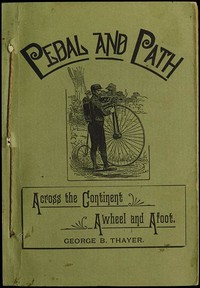
For Pedal and Path: Across the Continent Awheel and Afoot — Themes and Context, the stored edition analysis reports 82,070 words, 5 hr 57 min estimated reading time, and 29 detected text sections.
The text analysis averages about 29.4 words per sentence, while the detected sections provide another way to judge how the source is divided.
Project Gutenberg metadata also associates the work with “United States -- Description and travel,” connecting these edition facts with the source record’s subject description.
Explore this collection
These alternatives are selected using recorded categories and estimated reading time.
About 296 minutes
Travel Narratives
67,996 recorded words. 61 minutes difference from this book's estimate.
View Gutenberg source #49491About 420 minutes
Travel Narratives
96,438 recorded words. 63 minutes difference from this book's estimate.
View Gutenberg source #49698About 277 minutes
Travel Narratives
63,633 recorded words. 80 minutes difference from this book's estimate.
View Gutenberg source #49042Search stored excerpts and compare books → Choose by your preferences →
Choices use stored catalog measurements. Estimates vary with reading speed. A shared category is a catalog label, not a claim that two books have the same argument or literary quality.
Search reads excerpt text stored with this catalog and links to its associated Gutenberg record. The connection is stored in the site database; this tool does not recheck that every excerpt is word-for-word identical to that external record. Excerpt search does not cover every chapter and does not verify historical publication dates.
Catalog snapshot checked: 2026-09-26. Coverage: 100 public books, 100 available source excerpts.
Calculated from edition completeness, EPUB availability, text structure and catalogue metadata. Not a user rating.
Total of 100 points, scaled to a 2.5-5.0 range. Editions with an empty description or a missing EPUB file are not scored.
Public-domain source text
The source text is kept in the dedicated reader, separate from this catalogue record and its commentary.
George B. Thayer begins his narrative not with a dramatic departure but with a confession of discontent: after a dozen years in mercantile business, he found relief on a bicycle. The preface traces a progression from short rides to a six-week, 1,200-mile tour of New England, each journey intensifying his desire to see the country. By the time he sets out for California, Thayer has established a pattern: he travels not to break records but for pleasure and knowledge, writing occasional letters to the Hartford Evening Post. This origin as serialized correspondence shapes the book's structure—episodic, immediate, and attentive to the people he meets.
Thayer’s preface is unusually candid about his motives. He describes a “feeling of discontent with the monotonous routine” of business, and his first vacation in years felt like a risk—he wondered “whether the sun would not stand still if I ventured out of my little orbit.” The bicycle becomes both a practical tool (he rides twelve miles to Hartford to buy goods) and a source of “intense delight.” This dual role—utility and pleasure—recurs throughout the trip. Thayer emphasizes that he has “no desire or intention of making or breaking any records,” a disclaimer that sets his account apart from contemporary cycling feats. Instead, he frames the journey as a way to acquire “knowledge of the country and the people who live in it.” The preface thus establishes a modest, observant persona, one that will later prove willing to engage with strangers and ask questions.
In Salt Lake City, Thayer’s narrative shifts from landscape description to social investigation. He recounts a comic misunderstanding: hearing a knock at his hotel door, he assumes a crowd has gathered to see him, and trembles at the prospect of making a speech. The “crowd” turns out to be “two men and a boy, sitting under the trees with their feet cocked up, reading, unconcernedly.” This deflation is typical of Thayer’s self-deprecating humor. More seriously, he interviews a Mormon cyclist who tells him that “every member of the club is a Mormon” and that Eastern tourists are “afraid to ask us questions.” Thayer also speaks with the editor of the Tribune, who disputes the claim that only one-eighth of Mormons practice polygamy, arguing the figure is closer to one-half. Thayer admits his knowledge is “only superficial” after a two-day stop, yet he ventures a prediction: “Polygamy must go.” The passage shows him weighing conflicting testimony without resolving it.
Thayer’s description of bathing in the Great Salt Lake is one of the book’s most sensory passages. He notes that the water is so dense that “you can’t swim in it. It is almost like trying to swim in thin mud.” The lake’s buoyancy is a novelty: “It is only three or four years since the people of the city have availed themselves of the benefits of their salt water to any great extent.” Thayer observes that cheap excursion trains now bring back “2,000 passengers” from the lake twenty miles away. The detail is characteristic of his method: he records what he sees and hears without embellishment, letting the numbers and physical sensations speak for themselves. The lake becomes a microcosm of the West’s transformation—a natural wonder being packaged for tourism, even as Thayer himself participates in that tourism.
Thayer acknowledges that the book is “to all purposes a binding of those letters, with considerable revision.” The original letters were “sometimes rather meagre from having been written out in the fields to escape too curious observation of passers-by.” This admission reveals the practical constraints of his method: he wrote in the open, dodging onlookers. The revision process allowed him to “give fuller details at certain interesting points” and “round out a narrative.” Readers should therefore expect a hybrid text—part immediate dispatch, part retrospective polish. The episodic structure, with each chapter likely corresponding to a letter, means that the book moves from town to town without a strong overarching plot. Thayer’s voice remains consistent: curious, self-aware, and more interested in people than in scenery. The result is a travelogue that feels both personal and reportorial.
Thayer’s account rewards readers who attend to his offhand remarks and the people he quotes. He rarely lingers on landscapes; instead, he captures the texture of daily life in 1880s America—the Mormon cyclist who sets the record straight, the editor who parses statistics, the bathers at Salt Lake. Because the book originated as newspaper letters, each section can be read independently. First-time readers may wish to start with the preface, which establishes Thayer’s tone, then sample a later chapter to see how his method holds over distance. The journey is less about reaching California than about the conversations along the way.
Years after Mr. Thayer’s wheels fell silent, I still recall his patient wonder at Utah’s wide valleys, and how a passing thought drifts to that older, statelier collection, American Scenery, Vol. 1 (of 2) or, Land, lake, and river illustrations of transatlantic nature — Key Ideas to Explore. One rode, the other painted, yet both held the same hushed reverence for a land still learning its own shape.
A brief reflection can help important ideas stay with you longer.