About 42 minutes
The Mentor: Venice, the Island City, Vol. 1, Num. 27, Serial No. 27 — Reading Companion
Travel Narratives
9,518 recorded words. 5 minutes difference from this book's estimate.
View Gutenberg source #49891
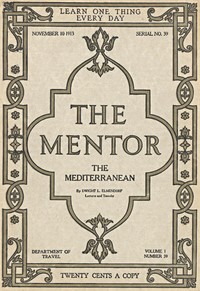
The Mentor: The Mediterranean, Vol. 1, Num. 39, Serial No. 39, November 10, 1913 — Reading Companion can be approached with a clearer sense of reading commitment from its source measurements: 10,664 words, 47 min estimated reading time, and 2 detected text sections.
The text analysis averages about 19.9 words per sentence, while the detected sections provide another way to judge how the source is divided.
Project Gutenberg metadata also associates the work with “Mediterranean Region -- Description and travel,” connecting these edition facts with the source record’s subject description.
Explore this collection
These alternatives are selected using recorded categories and estimated reading time.
About 42 minutes
Travel Narratives
9,518 recorded words. 5 minutes difference from this book's estimate.
View Gutenberg source #49891About 63 minutes
Travel Narratives
14,327 recorded words. 16 minutes difference from this book's estimate.
View Gutenberg source #49453About 205 minutes
Travel Narratives
47,063 recorded words. 158 minutes difference from this book's estimate.
View Gutenberg source #49043Search stored excerpts and compare books → Choose by your preferences →
Choices use stored catalog measurements. Estimates vary with reading speed. A shared category is a catalog label, not a claim that two books have the same argument or literary quality.
Search reads excerpt text stored with this catalog and links to its associated Gutenberg record. The connection is stored in the site database; this tool does not recheck that every excerpt is word-for-word identical to that external record. Excerpt search does not cover every chapter and does not verify historical publication dates.
Catalog snapshot checked: 2026-09-26. Coverage: 100 public books, 100 available source excerpts.
Calculated from edition completeness, EPUB availability, text structure and catalogue metadata. Not a user rating.
Total of 100 points, scaled to a 2.5-5.0 range. Editions with an empty description or a missing EPUB file are not scored.
Public-domain source text
The source text is kept in the dedicated reader, separate from this catalogue record and its commentary.
Dwight L. Elmendorf opens his 1913 travelogue for The Mentor by drawing a sharp contrast: across the Straits of Gibraltar lies “another and very different world.” Tangier and the Barbary coast present conditions and a civilization so unlike those of Spain and France that a traveler can scarcely believe the short distance separating them. This initial opposition sets the pattern for the entire number, which moves from the exotic south to the familiar pleasures of the Riviera, then to the peculiar principality of Monaco. Elmendorf, a lecturer and traveler, writes in a brisk, informative style aimed at the Association’s goal of imparting “useful knowledge without effort.” The text is punctuated by specific details—mileages, tunnel counts, and financial figures—that ground the picturesque descriptions in hard fact.
Elmendorf’s first section emphasizes the abrupt change a traveler experiences when crossing from Gibraltar to Tangier. He describes the Barbary coast as a place of “contrasting conditions” and a civilization “so different” from that of Europe that disbelief sets in. The phrasing is deliberately evocative: the reader is invited to “wander along the Barbary coast” and encounter a world apart. Yet the excerpt provides only this brief glimpse; the full treatment of North Africa is cut short. What remains is a clear rhetorical strategy: the author uses the shock of difference to frame the Mediterranean as a sea of cultural boundaries, not just a body of water. The contrast is not merely scenic but civilizational, a theme that would have resonated with early twentieth-century readers accustomed to imperial travel narratives.
The Riviera section balances lyrical description with practical data. Elmendorf notes “little churches and chapels peering from the somber foliage of cypresses” and “gigantic gray pinnacles of rock frowning upon the smiling plains,” a personification that animates the landscape. He catalogs the flora—olives, figs, vines, citrons, oranges, oleanders, myrtles, aloes—and mentions that “even palms are seen occasionally.” But he also reports that the railway from Nice to Genoa runs 116 miles, and that the stretch from Genoa to Spezia requires “more than 80 tunnels” through headlands. The only drawback, he states bluntly, is “its liability to earthquakes, of which there were four in the last century alone.” This mixture of aesthetic appeal and geological risk gives the passage a matter-of-fact tone typical of the Mentor series: beauty is quantified, and hazards are noted without alarm.
Elmendorf devotes a monograph to Monaco, calling it “a curious thing that the smallest country in Europe is also one of the most visited.” He specifies its area—eight square miles—and its population of 19,000. The reason for its fame is twofold: “its charming climate and situation, and its gaming tables.” He then provides a detailed financial history of the gambling concession, from François Blanc’s 1861 fifty-year lease to its extension in 1898 to 1947, with escalating annual payments to the prince: $350,000 in 1913, rising to $500,000 by 1937. These tributes, he explains, allow Monaco’s inhabitants to be “entirely exempt from taxation.” The section also notes that Mentone and Roquebrune were ceded to France in 1861 for $800,000, and that the city of Monaco occupies “the level summit of a rocky headland, rising about 200 feet from the shore.” The tone is neutral, almost statistical, yet the accumulation of figures underscores the economic oddity of a principality sustained by gambling revenue.
Elmendorf’s Mediterranean number is best read as a period piece that reveals early twentieth-century attitudes toward travel, civilization, and commerce. The author’s willingness to juxtapose the “alien” Barbary coast with the familiar Riviera, and to dissect Monaco’s gambling economy with precise numbers, offers a snapshot of how educated Americans were encouraged to see the region. Readers should note the tension between romantic description and factual reporting—a hallmark of the Mentor series—and consider how the text’s silences (the incomplete treatment of North Africa) shape its perspective.
I keep thinking about that old 1913 travel piece—how the writer drifted between alien coasts and familiar playgrounds, sensing something fragile beneath the leisure. It reminded me of another journey, quieter but just as lingering: Through South America — Edition Insights, where the landscape itself feels like a slow confession. Both left me sitting still afterward, maps half-open.
A brief reflection can help important ideas stay with you longer.