This volume pairs W.H. Bartlett's engravings with N.P. Willis's prose to depict American landscapes, moving from waterfalls and mountains to cities and monuments. The structure alternates between natural wonders and built environments, with recurring attention to vantage points, scale, and the interplay of wildness and cultivation.
Willis frequently describes scenes from a specific viewpoint—such as 'from below' or 'from above the ravine'—and notes how the observer's position shapes the impression. The text also weaves historical anecdotes, like Washington's survey of the Potomac, into the scenic descriptions, blending topography with national memory.
Vantage Points and Movement
The volume is organized around specific viewpoints, often indicated in chapter titles: 'The Catterskill Falls, from below' and 'from above the Ravine,' 'View of New York, from Weehawken,' 'View from Mount Ida, near Troy.' This emphasis on perspective invites the reader to imagine standing where the artist stood. Willis describes the descent to the torrent as 'steep and slippery,' foregrounding the physical effort required to reach certain views. The movement between scenes—from the Catskills to Lake George, from the Hudson to the Potomac—creates a tour-like rhythm, as if the reader is traveling alongside the author.
Scale and the Sublime
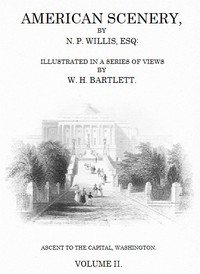
Willis repeatedly measures human constructions against natural forms. The Capitol is described in terms of its 'height, the ascending terraces, the monument and its fountain,' yet the waste lands at its foot 'might be marshes in the centre of a wilderness.' At Niagara, the ladder descent emphasizes the falls' overwhelming scale. The text often notes proportions: the 'imposing effect' of a building seen from a distance, or the way a natural bridge dwarfs the viewer. This tension between human ambition and nature's grandeur is a recurring structural device.
Historical Anecdotes Embedded in Landscape
Willis inserts narratives that anchor the scenery in national history. The account of Washington's survey of the Potomac—including the detail of a canoe 'hollowed out of a large poplar tree'—transforms a river view into a patriotic tableau. The anecdote of Washington's tears upon hearing of Colonel Crawford's death, and his exclamation about hurling spectators 'from that height into the abyss,' links a specific rock formation to a moment of raw emotion. These stories are not digressions; they layer the landscape with human significance, making topography a repository of memory.
Wildness Versus Cultivation
Throughout the volume, Willis contrasts untamed nature with signs of human order. The Capitol's site is described as 'thinly peopled,' its surroundings 'waste lands' awaiting a botanical garden. At Mount Auburn Cemetery, the cultivated grounds impose design on death. In contrast, the 'Silver Cascade' in the White Mountains is presented as purely natural. This dialectic reflects a broader 19th-century American concern: how to reconcile the sublime wilderness with the march of civilization. Willis does not resolve the tension but lets each scene speak to it.
Readers may find it useful to approach this volume as a series of paired encounters: first the engraving, then the prose. Willis's text often amplifies details the image cannot convey—sounds, historical associations, the effort of reaching a viewpoint. Noticing how he shifts between description, anecdote, and reflection can reveal the layered intentions behind this travelogue. The book rewards those who read with an eye for structure as much as for scenery.
That rainy afternoon, I kept returning to Bartlett’s engravings, particularly the vast Mississippi views, and Willis’s notes on scale. Something about the water and the leaning-in felt endless. Later, my hand drifted to Through South America — Edition Insights, and the river’s mood simply changed continent—the same patient current, just another latitude to follow into dusk.