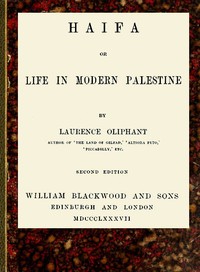
Haifa; or, Life in modern Palestine — Story, Setting & Ideas

(0 User reviews)   1501
In Category - Travel Narratives
Oliphant, Laurence, 1829-1888, Dana, Charles A. (Charles Anderson), 1819-1897 [Editor] Project Gutenberg 2015 Not confirmed
Palestine -- Description and travel Readers of public-domain and historical texts
Project Gutenberg digital edition en

Edition facts

Words 148,395
Reading time 646 min
Text sections 75

The source record for Haifa; or, Life in modern Palestine — Story, Setting & Ideas measures this digital text at 148,395 words, 10 hr 46 min estimated reading time, and 75 detected text sections.

The text analysis averages about 25.1 words per sentence, while the detected sections provide another way to judge how the source is divided.

Project Gutenberg metadata also associates the work with “Palestine -- Description and travel,” connecting these edition facts with the source record’s subject description.

Explore this collection

Compare your next read

These alternatives are selected using recorded categories and estimated reading time.

Search stored excerpts and compare books → Choose by your preferences →

How these choices and excerpts are prepared

Choices use stored catalog measurements. Estimates vary with reading speed. A shared category is a catalog label, not a claim that two books have the same argument or literary quality.

Search reads excerpt text stored with this catalog and links to its associated Gutenberg record. The connection is stored in the site database; this tool does not recheck that every excerpt is word-for-word identical to that external record. Excerpt search does not cover every chapter and does not verify historical publication dates.

Catalog snapshot checked: 2026-09-26. Coverage: 100 public books, 100 available source excerpts.

Laurence Oliphant's letters from Haifa blend archaeological observation, colonial settlement reporting, and geopolitical speculation, revealing tensions between religious prophecy and engineering ambition in 1880s Palestine.
Share
Editorial Edition Score 4.9/5

Calculated from edition completeness, EPUB availability, text structure and catalogue metadata. Not a user rating.

How this score is calculated
  • Description quality20 pts
  • Title & short description10 pts
  • Source metadata20 pts
  • Text length15 pts
  • Chapters / structure15 pts
  • EPUB file integrity20 pts

Total of 100 points, scaled to a 2.5-5.0 range. Editions with an empty description or a missing EPUB file are not scored.

Edition quality

Public-domain source text

Read the source text

The source text is kept in the dedicated reader, separate from this catalogue record and its commentary.

Laurence Oliphant's Haifa; or, Life in Modern Palestine collects letters originally written for the New York Sun during a three-year residence. The preface frames the work as distinct from tourist impressions, emphasizing the resident's access to archaeological research and ongoing colonial projects. Oliphant draws extensively on the Palestine Exploration Fund's findings, though he admits to quoting from memory when publications were unavailable. The resulting text oscillates between detailed site descriptions—such as the rock-hewn cemetery of Sheik Abreik—and speculative proposals, most notably a plan to flood the Jordan Valley to create an inland sea.

Archaeology and the Resident Observer

Oliphant positions himself as a resident rather than a passing pilgrim, claiming that “the impressions of a resident and those of a visitor are apt to differ widely.” He acknowledges his debt to the Palestine Exploration Fund and Captain Conder's Tent Work in Palestine, but his method is opportunistic: he popularizes technical findings for a general audience. The chapter on the rock-hewn cemetery of Sheik Abreik exemplifies this approach, blending firsthand observation with scholarly reference. Yet Oliphant is candid about his limitations, noting that he could not “define as exactly as I should have liked” the sources he used while “grubbing about.” This honesty underscores the tension between rigorous archaeology and the informal letter format.

Colonial Experiments and Sectarian Dynamics

Several chapters document nascent Jewish colonies and the German Temple Society settlements. Oliphant reports on “a Jewish Colony in its Infancy” and the “Temple Colonies in Palestine,” treating them as subjects of practical and political interest rather than theological significance. He notes the native population's excitement over government news in “Local Politics and Progress,” indicating a layered social landscape. The Temple Society, a German Protestant sect, receives particular attention, suggesting Oliphant's fascination with intentional communities. His reporting is observational, avoiding overt advocacy, but the very selection of these topics reflects a preoccupation with modernization and European influence in the region.

The Jordan Valley Canal: Prophecy and Engineering

One of the most striking passages details a proposal to cut a canal from the Mediterranean to the Dead Sea, submerging the Jordan Valley under an inland sea. Oliphant presents competing cost estimates—from £8 million to over £225 million—and weighs political obstacles: French protection of Latin monasteries, Russian ambitions in Jerusalem, and the potential ruin of the Suez Canal. He notes that the scheme is “keenly supported by one set of religionists” who cite Ezekiel 47:8–10, while opponents argue the prophecy would be negated by the submergence of En-gedi. Oliphant concludes that the project is likely impracticable but leaves the question open, acknowledging that “who can say in these days what science may not accomplish.” This section epitomizes the book's blend of biblical literalism, geopolitical calculation, and speculative engineering.

Readers should approach Haifa as a document of its time—a record of how a well-connected Victorian traveler processed Palestine through overlapping lenses of archaeology, colonial settlement, and prophecy. Oliphant's voice is that of a participant-observer who is simultaneously enchanted by ancient ruins and engaged with contemporary schemes. The letters reward selective reading: those interested in 19th-century exploration will find detailed site descriptions, while students of political history will note the early articulation of Zionist and imperialist projects. The work's value lies less in its conclusions than in the tensions it preserves.

I found myself thinking of my grandfather’s old photographs of Haifa, how the olive trees seemed older than the prophecies around them. That same stillness returned while leafing through American Scenery, Vol. 2 (of 2) or, Land, lake, and river illustrations of transatlantic nature — Reading Companion—a sense that every landscape outlasts the plans drawn upon it, waiting patiently for our restless minds to settle.

There are no reviews for this eBook.

0
0 out of 5 (0 User reviews )

Add a Review

Your Rating *
There are no comments for this eBook.

Reader reflection

What did you think of this book?

Answer a few questions and save a private reflection on this device.

Your progress 0 / 10
1

How far have you progressed with this book?

2

What was your overall reaction to the book?

3

Would you encourage someone else to read it?

4

How demanding did the text feel?

Related eBooks