About 420 minutes
Through South America — Edition Insights
Travel Narratives
96,438 recorded words. 72 minutes difference from this book's estimate.
View Gutenberg source #49698
For England and Canada A Summer Tour Between Old and New Westminster, with Historical Notes — Background and Themes, the stored edition analysis reports 113,133 words, 8 hr 12 min estimated reading time, and 31 detected text sections.
The text analysis averages about 19.9 words per sentence, while the detected sections provide another way to judge how the source is divided.
Project Gutenberg metadata also associates the work with “Canada -- Description and travel,” connecting these edition facts with the source record’s subject description.
Explore this collection
These alternatives are selected using recorded categories and estimated reading time.
About 420 minutes
Travel Narratives
96,438 recorded words. 72 minutes difference from this book's estimate.
View Gutenberg source #49698About 357 minutes
Travel Narratives
82,070 recorded words. 135 minutes difference from this book's estimate.
View Gutenberg source #49474About 646 minutes
Travel Narratives
148,395 recorded words. 154 minutes difference from this book's estimate.
View Gutenberg source #50026Search stored excerpts and compare books → Choose by your preferences →
Choices use stored catalog measurements. Estimates vary with reading speed. A shared category is a catalog label, not a claim that two books have the same argument or literary quality.
Search reads excerpt text stored with this catalog and links to its associated Gutenberg record. The connection is stored in the site database; this tool does not recheck that every excerpt is word-for-word identical to that external record. Excerpt search does not cover every chapter and does not verify historical publication dates.
Catalog snapshot checked: 2026-09-26. Coverage: 100 public books, 100 available source excerpts.
Calculated from edition completeness, EPUB availability, text structure and catalogue metadata. Not a user rating.
Total of 100 points, scaled to a 2.5-5.0 range. Editions with an empty description or a missing EPUB file are not scored.
Public-domain source text
The source text is kept in the dedicated reader, separate from this catalogue record and its commentary.
Sandford Fleming, a civil engineer and surveyor, wrote England and Canada after a summer journey from London to the Pacific coast. The book is structured as a series of dated entries, moving east to west, with historical chapters interspersed. Fleming’s voice is that of a practical observer: he notes the width of the Bow River compared to the Thames, the difficulty of poling a canoe upstream, and the “weird light” of forest fires at night. His dedication to the Marquis of Lorne signals the work’s political context—a record of travel through Canadian territory intended to promote imperial connection.
The book’s subtitle, “A Summer Tour Between Old and New Westminster,” announces a geographical and symbolic contrast. The table of contents divides the journey into an “Eastern Journey” and a “Western Journey,” though the narrative itself is continuous. Fleming begins in Halifax, crosses the Atlantic to Liverpool, and spends several chapters in England—visiting London, the Henley Regatta, and the Land’s End—before returning to Canada. The western half of the book describes travel by rail and horseback through Nova Scotia, Quebec, Ontario, and the Rocky Mountains. This structure allows Fleming to compare English and Canadian landscapes, customs, and infrastructure, often with a critical eye: he complains about “Custom House Annoyances” in England and praises the comfort of ocean voyages.
Fleming’s descriptions of the Rocky Mountains are among the most vivid passages in the excerpts. He writes of “towering battlements” and “Cyclopean masonry” at Castle Mountain, and notes the difficulty of capturing such scenes: “it would be impossible to portray them within the limits of ordinary canvas.” He also records sensory details—the smoky atmosphere from forest fires, the “weird light” of flames at night, and the stiffness of riders after a day’s drill. These observations are not merely scenic; they reflect the practical challenges of survey work. Fleming mentions that the fires explain the “thick, heavy, smoky atmosphere” that obscured mountain views, grounding his aesthetic impressions in material conditions.
Interspersed with travel narrative are historical chapters covering early colonization, the Acadian expulsion, and boundary disputes. Fleming’s tone is that of a Victorian chronicler: he recounts the “Deportation of the Acadians” and the “Peace of Aix la Chapelle” with a mixture of detachment and patriotic pride. The book’s dedication to the Marquis of Lorne, a Governor General of Canada, underscores its political purpose: to celebrate the transcontinental railway and the unification of British North America. Yet Fleming also includes personal moments, such as a Sunday service conducted by Dr. Grant in the mountains, attended by “men engaged on the surveys and works” and one woman from a nearby camp. These details humanize the grand narrative of nation-building.
Readers interested in the intersection of travel writing, engineering history, and Canadian nationalism will find England and Canada a rich primary source. Fleming’s eye for detail—the width of a river, the texture of burnt pine—grounds his imperial vision in tangible experience. The book rewards those who read slowly, attending to the shifts between personal anecdote and historical summary.
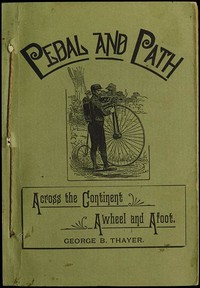
I was rereading Sandford Fleming’s account of his summer through old and new Westminster, struck by how he measured the empire’s pulse against the quiet rush of Canadian rivers. That patient, wheeling motion—the way landscape becomes both journey and memory—made me think of another traveler’s diary, Pedal and Path: Across the Continent Awheel and Afoot — Themes and Context, where the same frontier unfolds at a slower, more intimate pace, one pedal at a time.
Your answers remain private and are stored only in this browser.