About 47 minutes
The Mentor: The Mediterranean, Vol. 1, Num. 39, Serial No. 39, November 10, 1913 — Reading Companion
Travel Narratives
10,664 recorded words. 16 minutes difference from this book's estimate.
View Gutenberg source #49816
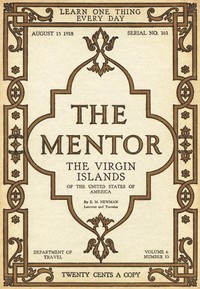
The catalog record for The Mentor: The Virgin Islands of the United States of America, Vol. 6, Num. 13, Serial No. 161, August 15, 1918 — A Reader’s Guide provides practical reading context through 14,327 words, 1 hr 3 min estimated reading time, and 7 detected text sections.
The text analysis averages about 16.5 words per sentence, while the detected sections provide another way to judge how the source is divided.
Project Gutenberg metadata also associates the work with “United States Virgin Islands -- Description and travel,” connecting these edition facts with the source record’s subject description.
Explore this collection
These alternatives are selected using recorded categories and estimated reading time.
About 47 minutes
Travel Narratives
10,664 recorded words. 16 minutes difference from this book's estimate.
View Gutenberg source #49816About 42 minutes
Travel Narratives
9,518 recorded words. 21 minutes difference from this book's estimate.
View Gutenberg source #49891About 205 minutes
Travel Narratives
47,063 recorded words. 142 minutes difference from this book's estimate.
View Gutenberg source #49043Search stored excerpts and compare books → Choose by your preferences →
Choices use stored catalog measurements. Estimates vary with reading speed. A shared category is a catalog label, not a claim that two books have the same argument or literary quality.
Search reads excerpt text stored with this catalog and links to its associated Gutenberg record. The connection is stored in the site database; this tool does not recheck that every excerpt is word-for-word identical to that external record. Excerpt search does not cover every chapter and does not verify historical publication dates.
Catalog snapshot checked: 2026-09-26. Coverage: 100 public books, 100 available source excerpts.
Calculated from edition completeness, EPUB availability, text structure and catalogue metadata. Not a user rating.
Total of 100 points, scaled to a 2.5-5.0 range. Editions with an empty description or a missing EPUB file are not scored.
Public-domain source text
The source text is kept in the dedicated reader, separate from this catalogue record and its commentary.
E. M. Newman opens his account of the Virgin Islands with a scene of arrival that is both specific and sensory: landing at St. Thomas in front of a square overhung by palm and mango trees, shaded by lofty ferns. The prose immediately establishes a pattern of contrast—the picturesque and the gritty, the natural and the human. Children are described as “dressed in black, as nature made them,” a phrase that signals the author’s tendency to blend observation with a detached, sometimes jarring, colonial perspective. The narrative voice moves fluidly between painterly description and blunt reportage, a duality that shapes the entire work.
Newman’s descriptive style is most vivid when he turns to the islands’ topography. St. Croix, he writes, “consists of a multitude of little peaks and rounded hills, with ravines and valleys between them.” The color palette is precise: uncultivated mountains are “a bluish green,” while sugar-cane fields glow with “so light and rich a green that it seems as if Spring had just spread her mantle over the land.” The prose becomes almost animated when describing plantations that “sweep their waves of golden-green down to kiss the white sea-waves.” Yet this lyricism is undercut by the author’s readiness to puncture romantic expectation. Upon landing at Frederiksted, the “vision vanished”: arcades were “clumsy and crumbling,” streets unpaved, and cabins “far from picturesque.” The shift from anticipation to disappointment is abrupt, and Newman does not soften it.
The narrator’s tone is consistently that of an outsider reporting on a foreign society. He notes that the Danes “were unable to teach them their language,” referring to the Black inhabitants, and that practically all speak English “with that peculiar drawl that has become familiar to us in Jamaica.” The phrase “us” aligns the reader with the author’s perspective, reinforcing a sense of distance. Newman’s characterization of the local population is reductive: “They are a simple, childlike people, with bodies of men and women but with the intellect of the average child.” Such statements reflect the racial attitudes of the era and are essential to understanding the text’s historical context. The narrative voice does not question these assumptions; it presents them as matter-of-fact, which gives the work a documentary quality tinged with condescension.
The pacing of the text varies noticeably between descriptive passages and anecdotal asides. A long, measured account of Charlotte Amalie’s commerce—its free port history, the decline after duties were imposed—is followed by a sudden, almost folkloric story about a pirate’s wife who poisoned seven women. This “Island Bluebeard” tale is told with a light, narrative flair: “She did not kill her husband, instead she invited the women to an afternoon tea at her home and poisoned all seven.” The story ends with a rescue and a happily-ever-after, a sharp tonal shift from the preceding economic analysis. Similarly, the description of Louis Monsanto’s “graveyard of ships” on Krum Bay introduces a macabre detail—figureheads with “stories of thrilling escapes and tragic loss of life”—that breaks the rhythm of factual reporting. These interludes suggest that Newman, despite his documentary intent, was drawn to the islands’ lore and used it to vary the tempo of his account.
Newman’s narrative is best approached as a period document that reveals as much about the observer as about the observed. Readers attentive to shifts in register—from lyrical landscape to blunt social comment, from economic summary to anecdote—will find a text that resists easy categorization. The work’s value lies not in its completeness but in its candid, sometimes uncomfortable, reflection of early twentieth-century travel writing and American imperial attitudes.
Flipping through Newman’s 1918 Islands, I felt the same quiet ache of places shifting under observation—how a traveler’s eye both loves and distances. It reminded me, oddly, of a summer walk between old and new Westminsters, where history hums beneath ordinary streets. Something about that steady companionship of land and memory lingers: England and Canada A Summer Tour Between Old and New Westminster, with Historical Notes — Background and Themes. Just a feeling.
Use these questions to collect your thoughts before moving on.