About 340 minutes
Stories of the Gorilla Country, Narrated for Young People — Text and Context
Exploration
78,019 recorded words. 9 minutes difference from this book's estimate.
View Gutenberg source #52444
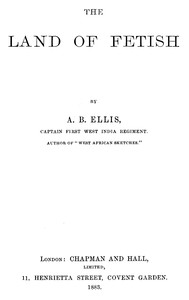
This digital edition of The Land of Fetish — A Closer Reading is described by source-level measurements including 76,118 words, 5 hr 31 min estimated reading time, and 7 detected text sections.
The text analysis averages about 29.8 words per sentence, while the detected sections provide another way to judge how the source is divided.
Project Gutenberg metadata also associates the work with “Africa, West -- Description and travel,” connecting these edition facts with the source record’s subject description.
Explore this collection
These alternatives are selected using recorded categories and estimated reading time.
About 340 minutes
Exploration
78,019 recorded words. 9 minutes difference from this book's estimate.
View Gutenberg source #52444About 342 minutes
Exploration
78,445 recorded words. 11 minutes difference from this book's estimate.
View Gutenberg source #58768About 379 minutes
Exploration
87,151 recorded words. 48 minutes difference from this book's estimate.
View Gutenberg source #69091Search stored excerpts and compare books → Choose by your preferences →
Choices use stored catalog measurements. Estimates vary with reading speed. A shared category is a catalog label, not a claim that two books have the same argument or literary quality.
Search reads excerpt text stored with this catalog and links to its associated Gutenberg record. The connection is stored in the site database; this tool does not recheck that every excerpt is word-for-word identical to that external record. Excerpt search does not cover every chapter and does not verify historical publication dates.
Catalog snapshot checked: 2026-09-26. Coverage: 100 public books, 100 available source excerpts.
Calculated from edition completeness, EPUB availability, text structure and catalogue metadata. Not a user rating.
Total of 100 points, scaled to a 2.5-5.0 range. Editions with an empty description or a missing EPUB file are not scored.
Public-domain source text
The source text is kept in the dedicated reader, separate from this catalogue record and its commentary.
A. B. Ellis, a British army officer stationed in West Africa, wrote The Land of Fetish in 1883 as a travelogue and ethnographic survey. The narrative voice is that of a colonial administrator who oscillates between detached cataloging of customs and vivid, sometimes sardonic, personal anecdotes. Ellis describes the Egugu man as “the personification of the English ‘bogey’ with which nurses terrify children,” a simile that reveals his attempt to render unfamiliar practices through domestic analogies. The prose is dense with specific details—the ingredients of “recherché dishes of savage African cookery,” the mechanics of Dahoman military drill, the geography of the Niger Delta—but the pace is uneven: long passages of factual exposition are punctuated by sudden, dramatic set-pieces, such as a night adventure in Bonny or a struggle with sharks. This alternation between report and story gives the work a restless energy, as if Ellis himself were torn between the demands of scientific observation and the pull of narrative.
Ellis’s prose often adopts a clinical tone when describing social structures, as when he notes that among the Jolloffs “musical instruments” and “burial custom” are cataloged without commentary. Yet this neutrality is frequently undercut by ironic asides. Describing the Egugu man’s method of exposing adulterous wives, Ellis remarks that “it would be difficult in any case to pick out a guiltless woman,” a wry observation that hints at his skepticism toward the practice’s efficacy. Similarly, his account of Dahoman human sacrifices is matter-of-fact, but the phrase “importunate relatives” injects a note of dark humor. This tonal shift—from detached recorder to amused commentator—creates a layered narrative voice that does not simply report but also judges, often through understatement. The reader is left to navigate between Ellis’s stated objectivity and his implied critique.
The book’s structure mirrors the author’s journey along the West African coast, moving from the Gambia to Sierra Leone, with each chapter focused on a different locale. However, Ellis frequently interrupts the geographical progression with extended digressions: a chapter on Ashanti politics since 1874 sits alongside one on the Niger Delta’s “gloomy region” and cannibals. These shifts in subject matter are accompanied by changes in narrative pace. Descriptions of natural features—such as “floating islands” or “flying foxes”—are often brief and lyrical, while accounts of diplomatic missions or military expeditions are dense with detail and slow-moving. The most dramatic passages, like the “night adventure” in Bonny or the “struggle with sharks,” are set apart by their heightened tempo and sensory language, creating a rhythm that alternates between the leisurely pace of ethnographic exposition and the urgency of personal anecdote.
Throughout the excerpts, Ellis returns to specific objects and practices that illuminate the intersection of power, belief, and daily life. The “snake house” at Whydah, the “golden axe” of Cape Coast, and the “fetishes” encountered in Badagry are described with a mix of curiosity and condescension. He notes that Dahoman priests use “various gods” and perform “a curious ceremony,” but he does not elaborate on their meanings, leaving the reader with a sense of partial understanding. The material culture of punishment is also prominent: “capital punishments” in Old Calabar, “human sacrifices” at the Annual Customs, and the “professional poisoners” of Sherbro who “compound and prepare these poisons with great secrecy.” These recurring motifs—objects and rituals tied to authority and fear—serve as anchors for Ellis’s observations, but they are rarely analyzed in depth, suggesting that the author’s primary interest lies in the spectacle rather than the system.
Readers approaching The Land of Fetish should attend to the shifts in Ellis’s narrative register—from the dry cataloging of customs to the vivid, almost novelistic, set-pieces. The book is best read not as a systematic ethnography but as a personal account shaped by the author’s position as a colonial officer. Pay attention to the moments when Ellis’s tone becomes ironic or dismissive, as these reveal his underlying assumptions. The work’s value lies less in its factual accuracy than in its portrayal of a Victorian mind grappling with unfamiliar cultures, and in the uneven rhythm that mirrors the unpredictability of travel itself.
Years among the stacks taught me that Ellis’s wry cataloguing of Dahoman rites holds a strange, quiet kinship with the solitary walker crossing the Pampas—both men measuring foreign silences with their own weary, watchful eyes. I recall The Pampas and Andes: A Thousand Miles' Walk Across South America — Text and Context as a gentler echo, yet the same patient loneliness hums beneath each page. A shared whisper across oceans.
Answer a few questions and save a private reflection on this device.