About 510 minutes
Through Timbuctu and across the great Sahara — Text and Context
Exploration
117,232 recorded words. 115 minutes difference from this book's estimate.
View Gutenberg source #70221
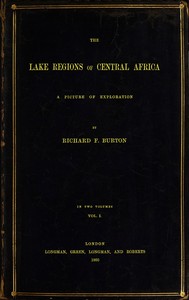
Before opening The Lake Regions of Central Africa: A Picture of Exploration, Vol. 1 — Reading Notes, the edition data offers a quick orientation: 143,660 words, 10 hr 25 min estimated reading time, and 25 detected text sections.
The text analysis averages about 19.2 words per sentence, while the detected sections provide another way to judge how the source is divided.
Project Gutenberg metadata also associates the work with “Africa, Central -- Description and travel,” connecting these edition facts with the source record’s subject description.
Explore this collection
These alternatives are selected using recorded categories and estimated reading time.
About 510 minutes
Exploration
117,232 recorded words. 115 minutes difference from this book's estimate.
View Gutenberg source #70221About 383 minutes
Exploration
87,962 recorded words. 242 minutes difference from this book's estimate.
View Gutenberg source #54501About 379 minutes
Exploration
87,151 recorded words. 246 minutes difference from this book's estimate.
View Gutenberg source #69091Search stored excerpts and compare books → Choose by your preferences →
Choices use stored catalog measurements. Estimates vary with reading speed. A shared category is a catalog label, not a claim that two books have the same argument or literary quality.
Search reads excerpt text stored with this catalog and links to its associated Gutenberg record. The connection is stored in the site database; this tool does not recheck that every excerpt is word-for-word identical to that external record. Excerpt search does not cover every chapter and does not verify historical publication dates.
Catalog snapshot checked: 2026-09-26. Coverage: 100 public books, 100 available source excerpts.
Calculated from edition completeness, EPUB availability, text structure and catalogue metadata. Not a user rating.
Total of 100 points, scaled to a 2.5-5.0 range. Editions with an empty description or a missing EPUB file are not scored.
Public-domain source text
The source text is kept in the dedicated reader, separate from this catalogue record and its commentary.
Richard F. Burton opens his preface by defending the explorer's right to offer interpretation alongside observation, a stance that shapes this entire volume. He describes his work as an 'antipathetic cento'—a mingling of the gay with the graver details of travel—produced after his publishers rejected a purely 'light work.' The result is a narrative that moves between personal adventure and systematic ethnography, as seen in the detailed account of Wasagara dress and ornament.
Burton explicitly challenges the directive that explorers should 'eschew theory and opinion' and confine themselves to transmitting raw material. He asks, 'why may not the observer be allowed a voice concerning his own observations, if at least his mind be sane and his stock of collateral knowledge be respectable?' This defense of intellectual agency is woven into the text: Burton does not simply list facts about the Wasagara but interprets their material culture. He notes, for instance, that the people have 'neither invented nor borrowed the principles of rude tanning' despite long use of hides, a pointed observation that goes beyond mere description. His voice is present in such judgments, making the work as much a record of a Victorian mind encountering Africa as a record of Africa itself.
Burton's ethnography of the Wasagara focuses intensely on clothing and ornament as indicators of wealth, status, and taste. He distinguishes between the shukkah of the wealthy—indigo-dyed or unbleached cotton—and the 'calabash-campestre' or softened skins of the poor. The description of how skins are prepared—'pegged, to prevent shrinking, inside upwards, in the sun'—reveals a practical eye for process. Burton also notes that 'dressy gentlemen' favor appendages like the legs and tail of the animal, and that children's attire ranges from 'an apron of thin twine' to 'a screen of tin plates.' The weight of beads and wire is explicitly 'the test of wealth and respectability,' tying ornament directly to social standing.
Burton's observations are punctuated by moments of cultural comparison that highlight what he sees as technological gaps. He remarks that the Wasagara have not adopted tanning with mimosa-bark, 'an art so well known to most tribes of barbarians.' Instead, they rely on dirt and grease to soften skins—'after a few days’ wear, dirt and grease have almost done the duty of tanning.' Such comments reflect Burton's own framework of progress and civilization, but they also capture specific practices: the way a traveler doffs his skin garment during rain and places it 'between the burden and the shoulder' to have a 'dry shirt' at camp. These details ground the narrative in concrete, observable behavior.
Burton's preface warns that he has not avoided 'intruding matters of a private and personal nature,' and the reader should expect a narrative shaped by a strong, sometimes contentious, personality. The ethnographic passages reward close attention to material specifics—how a garment is tied, what ornaments weigh, how skin is prepared—rather than broad generalizations. This volume offers a Victorian explorer's view of East Africa, filtered through a mind that insisted on its right to think as well as see.
Reading Burton’s careful notes on the Wasagara’s beadwork, I felt that gentle patience he had for small details, and it reminded me of another voice from the same era—one that also lingered on textures and curious sights, though aimed at younger ears. Stories of the Gorilla Country, Narrated for Young People — Text and Context carries that same unhurried wonder, as if both travelers simply noticed the world and let it speak.
Answer a few questions and save a private reflection on this device.