About 342 minutes
On Horseback Through Asia Minor, Volume 1 (of 2) — Background and Themes
Exploration
78,445 recorded words. 2 minutes difference from this book's estimate.
View Gutenberg source #58768
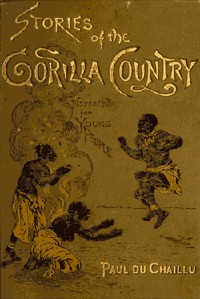
Stories of the Gorilla Country, Narrated for Young People — Text and Context can be approached with a clearer sense of reading commitment from its source measurements: 78,019 words, 5 hr 40 min estimated reading time, and 10 detected text sections.
The text analysis averages about 18.1 words per sentence, while the detected sections provide another way to judge how the source is divided.
Project Gutenberg metadata also associates the work with “Africa, West -- Description and travel,” connecting these edition facts with the source record’s subject description.
Explore this collection
These alternatives are selected using recorded categories and estimated reading time.
About 342 minutes
Exploration
78,445 recorded words. 2 minutes difference from this book's estimate.
View Gutenberg source #58768About 331 minutes
Exploration
76,118 recorded words. 9 minutes difference from this book's estimate.
View Gutenberg source #65997About 379 minutes
Exploration
87,151 recorded words. 39 minutes difference from this book's estimate.
View Gutenberg source #69091Search stored excerpts and compare books → Choose by your preferences →
Choices use stored catalog measurements. Estimates vary with reading speed. A shared category is a catalog label, not a claim that two books have the same argument or literary quality.
Search reads excerpt text stored with this catalog and links to its associated Gutenberg record. The connection is stored in the site database; this tool does not recheck that every excerpt is word-for-word identical to that external record. Excerpt search does not cover every chapter and does not verify historical publication dates.
Catalog snapshot checked: 2026-09-26. Coverage: 100 public books, 100 available source excerpts.
Calculated from edition completeness, EPUB availability, text structure and catalogue metadata. Not a user rating.
Total of 100 points, scaled to a 2.5-5.0 range. Editions with an empty description or a missing EPUB file are not scored.
Public-domain source text
The source text is kept in the dedicated reader, separate from this catalogue record and its commentary.
Paul Du Chaillu's Stories of the Gorilla Country moves through West Africa in a pattern of departure, encounter, and return. The narrative repeatedly leaves a coastal village for a hunting camp or inland journey, then circles back to a king's settlement. This back-and-forth structure gives the book a rhythmic quality, each excursion framed by the logistics of provisioning canoes, hiring men, and packing salt, nets, and guns. The excerpts show Du Chaillu paying close attention to the practical details of travel—how many oarsmen, what kind of mats for sleeping, the fibre used for fish-nets—while also noting the natural threats that recur at each stage: leopards that scavenge kills, snakes that drop from trees, and the ever-present fever.
Leopards appear so often in these excerpts that they become a structural motif. In one passage, a leopard eats half a cow before the hunters return; in another, Du Chaillu notes that leopards lurk in the jungle near Cape Lopez. The animal is not merely a danger but a marker of the wild spaces between settlements. When Du Chaillu writes that he did not grudge the leopard his meal, he signals a pragmatic acceptance of predation as part of the landscape. The leopard also appears as a scavenger, a threat to camp meat, and a creature whose skin he might have given to friends. This repeated mention builds a sense of an environment where human activity is constantly shadowed by animal hunger.
The narrative's geography is defined by a series of departures and returns. Du Chaillu leaves Sangatanga for a hunting expedition, then returns to find the king ill. He prepares a fishing excursion to Fetich Point, crossing the bay in a canoe with sixteen oarsmen. The journey to the cannibal country begins with a trek through wilderness, and later he builds an olako (a shelter) in the woods. Each movement is accompanied by a list of supplies: powdered manioc, ground nuts, sweet potatoes, plantains, mats, kettles, salt, nets, hooks. These inventories ground the travelogue in material reality. The reader is never allowed to forget that every stage of the journey requires negotiation with local rulers, recruitment of men, and careful packing of provisions.
Two recurring elements—the tornado and the fever—function as interruptions that reset the narrative. In chapter III, a tornado appears alongside leopards prowling and a fight with a buffalo; the chapter ends with Du Chaillu sick with fever. Later, after returning from a hunt, he finds the king in worse health. These episodes break the forward momentum of travel and force pauses. The tornado is a sudden, violent weather event that disrupts the routine of camp life, while the fever imposes stillness on the narrator himself. Together, they create a rhythm of exertion and collapse, adventure and recovery, that shapes the pacing of the book.
Du Chaillu weaves observations of local customs into the travel narrative without stopping the action. While describing a fishing party, he mentions that the women carried baskets and that the men boasted of the tobacco they would get for smoked meat. He notes the burial-ground of the Oroungous near Fetich Point, and earlier, the coronation of a new king and the killing of an old man for witchcraft. These details are not presented as separate ethnographic chapters but arise naturally from the journey. The reader learns about cannibal diet, musical instruments, and blacksmith tools only when Du Chaillu arrives among the cannibals. This method keeps the focus on movement while still delivering cultural information.
Readers will find that the book's structure rewards attention to the spaces between hunts and the items packed for each trip. The recurring images of leopards, snakes, and tornados are not merely decorative but serve as anchors for the narrative's geography. By following the pattern of departure, encounter, and return, one can trace how Du Chaillu builds a portrait of West Africa that is both adventurous and meticulously observed.
I keep returning to the hunting scenes—those tense, quiet moments under the West African canopy. The leopards and tornados return again in Stories of the Gorilla Country, as if nature itself wrote the pacing. There is a gentler echo of that patient urgency in The Land of Fetish — A Closer Reading. They share a slow, observant breath. Like friends who rarely speak but know each other well.
Build a private reading journal entry for this title.