About 340 minutes
Stories of the Gorilla Country, Narrated for Young People — Text and Context
Exploration
78,019 recorded words. 2 minutes difference from this book's estimate.
View Gutenberg source #52444
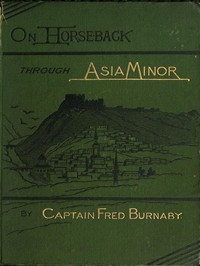
The source record for On Horseback Through Asia Minor, Volume 1 (of 2) — Background and Themes measures this digital text at 78,445 words, 5 hr 42 min estimated reading time, and 39 detected text sections.
The text analysis averages about 17.9 words per sentence, while the detected sections provide another way to judge how the source is divided.
Project Gutenberg metadata also associates the work with “Turkey -- Description and travel,” connecting these edition facts with the source record’s subject description.
Explore this collection
These alternatives are selected using recorded categories and estimated reading time.
About 340 minutes
Exploration
78,019 recorded words. 2 minutes difference from this book's estimate.
View Gutenberg source #52444About 331 minutes
Exploration
76,118 recorded words. 11 minutes difference from this book's estimate.
View Gutenberg source #65997About 379 minutes
Exploration
87,151 recorded words. 37 minutes difference from this book's estimate.
View Gutenberg source #69091Search stored excerpts and compare books → Choose by your preferences →
Choices use stored catalog measurements. Estimates vary with reading speed. A shared category is a catalog label, not a claim that two books have the same argument or literary quality.
Search reads excerpt text stored with this catalog and links to its associated Gutenberg record. The connection is stored in the site database; this tool does not recheck that every excerpt is word-for-word identical to that external record. Excerpt search does not cover every chapter and does not verify historical publication dates.
Catalog snapshot checked: 2026-09-26. Coverage: 100 public books, 100 available source excerpts.
Calculated from edition completeness, EPUB availability, text structure and catalogue metadata. Not a user rating.
Total of 100 points, scaled to a 2.5-5.0 range. Editions with an empty description or a missing EPUB file are not scored.
Public-domain source text
The source text is kept in the dedicated reader, separate from this catalogue record and its commentary.
Captain Fred Burnaby, already known for A Ride to Khiva, set out in 1876 to cross Asia Minor on horseback during a five-month leave of absence. His route covered over 2000 miles, and he spoke with pashas, farmers, and peasants about the impending war with Russia. Burnaby presents his work as a 'verbal photograph' of what he saw and heard, deliberately avoiding extended stays in major towns. The narrative is shaped by the tension between Ottoman hospitality and the material decay of the empire, a pattern visible from the preface onward.
Burnaby repeatedly notes the juxtaposition of classical wealth and contemporary poverty. Near Sekili, he describes hovels 'built of marble' with roofs of mud-covered beams, the 'pure white rock presenting a striking contrast to its filthy surroundings.' Marble blocks lie scattered, remnants of ancient quarries that once supplied palaces. The author's reflection is blunt: 'Poor Turkey, she has descended the steps of civilization, and not ascended them like European nations.' Yet he immediately qualifies this by asserting that the Turks themselves remain unchanged, their hospitality as abundant as in the days of Mohammed II. This pattern—decay of infrastructure paired with constancy of character—recurs throughout the excerpts.
Burnaby records direct speech from locals, giving the narrative a documentary quality. An old farmer near Angora laments the famine that killed his cattle and goats, noting that snow blocked roads for three and a half months, leaving food aid undelivered. When asked about enthusiasm for war, the farmer replies: 'Immense... it is a question not only of religion but also of property.' He fears Russian assessors who would 'grind us down to the last piastre' and forced conversion. His son, eager to join the sultan's forces, is told by the father: 'Your time will come soon enough.' The farmer's final declaration—'Our land shall drink our blood ere we give up one foot of soil'—captures a defiant patriotism tempered by the sorrow of a parent who has seen men return killed from Servia.
Burnaby's account is grounded in the physical realities of horseback travel. When his grey horse goes lame after a kick from the guide's animal, he swaps mounts with Osman, who is lighter. He describes the 'Rahvan, or ambling horse,' whose pace is 'easy for the rider' at about five miles an hour, compared to the ordinary walk of Turkish horses at 'not much above three.' Such details anchor the narrative in specific, practical observations. The journey's pace also shapes the scope of Burnaby's observations: limited leave meant only a few days in each town, yet this constraint becomes a strength, forcing him to rely on roadside encounters rather than official interviews.
Burnaby's preface frames the work as a record of impressions, not a comprehensive study. Readers should approach the text as a snapshot of Anatolia in 1876–77, filtered through the author's military background and his evident sympathy for Turkish hospitality. The volume ends without resolution of the war's outcome; the second volume continues the journey. Pay attention to the way Burnaby weaves his own physical discomfort—laming horses, bad roads, limited time—into the larger story of a struggling empire.
Reading Burnaby’s mud hovels beside those marble ruins, I remembered a dusty afternoon with Through Timbuctu and across the great Sahara — Text and Context—that same ache of layered time, how a place holds both its glory and its ruin without flinching. Both books left me staring out a window, quietly undone.
Save your reaction, strongest insight, and memorable passage.