About 164 minutes
The Isle of Vanishing Men: A Narrative of Adventure in Cannibal-land — Inside the Classic
Exploration
37,649 recorded words. 7 minutes difference from this book's estimate.
View Gutenberg source #57881
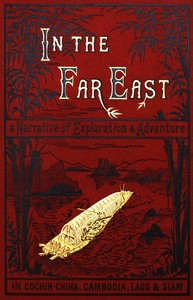
In the Far East A Narrative of Exploration and Adventure in Cochin-China, Cambodia, Laos, and Siam — A Reader’s Guide can be approached with a clearer sense of reading commitment from its source measurements: 35,971 words, 2 hr 37 min estimated reading time, and 13 detected text sections.
The text analysis averages about 21.4 words per sentence, while the detected sections provide another way to judge how the source is divided.
Project Gutenberg metadata also associates the work with “Indochina -- Description and travel,” connecting these edition facts with the source record’s subject description.
Explore this collection
These alternatives are selected using recorded categories and estimated reading time.
About 164 minutes
Exploration
37,649 recorded words. 7 minutes difference from this book's estimate.
View Gutenberg source #57881About 193 minutes
Exploration
44,344 recorded words. 36 minutes difference from this book's estimate.
View Gutenberg source #62138About 331 minutes
Exploration
76,118 recorded words. 174 minutes difference from this book's estimate.
View Gutenberg source #65997Search stored excerpts and compare books → Choose by your preferences →
Choices use stored catalog measurements. Estimates vary with reading speed. A shared category is a catalog label, not a claim that two books have the same argument or literary quality.
Search reads excerpt text stored with this catalog and links to its associated Gutenberg record. The connection is stored in the site database; this tool does not recheck that every excerpt is word-for-word identical to that external record. Excerpt search does not cover every chapter and does not verify historical publication dates.
Catalog snapshot checked: 2026-09-26. Coverage: 100 public books, 100 available source excerpts.
Calculated from edition completeness, EPUB availability, text structure and catalogue metadata. Not a user rating.
Total of 100 points, scaled to a 2.5-5.0 range. Editions with an empty description or a missing EPUB file are not scored.
Public-domain source text
The source text is kept in the dedicated reader, separate from this catalogue record and its commentary.
Adams begins In the Far East with a geographical overview of Cambodia, defining its boundaries and political status as of the 1870s. The opening chapter quickly shifts to the Mekong River, describing its course from China through Laos. This factual, encyclopedic tone sets the stage for a narrative that depends heavily on the accounts of French explorers like Francis Garnier and Dr. Morice.
The table of contents reveals that the book is structured around distinct journeys: Garnier's Mekong expedition, Morice's travels, and Mouhot's Cambodian explorations. Adams does not present his own firsthand observations but synthesizes these sources. The excerpts show that he often names his informants, as in "Dr. Morice and the Mekong" and "M. Mouhot in Cambodia." This reliance on others' narratives means the reader encounters the region through a secondary lens, with Adams acting as a compiler rather than a participant. The text's authority derives from the credibility of the explorers cited, not from the author's direct experience.
Adams's prose is marked by precise geographical details—latitudes, river courses, and distances—but also by cultural observations. In the Morice chapter, he reports the explorer's initial disgust at Annamite features, noting "those faces more or less flattened" and "those livid eyes." This passage reveals a colonial gaze that measures local appearance against European ideals. The author does not soften these judgments; instead, he records Morice's eventual adjustment to the unfamiliar. Such moments offer insight into 19th-century attitudes, but readers should note that Adams is relaying Morice's perspective, not his own.
The list of twenty-eight full-page illustrations—from "Laotian Boat Descending a Rapid" to "Chinese Merchants of Saigon"—suggests that visual evidence was integral to the book's appeal. The frontispiece and other plates depict scenes of travel, hunting, and local customs. In the HTML edition, blue-bordered images link to larger versions, indicating that the illustrations were designed to be studied closely. These images likely complement the text's descriptive passages, offering readers a visual counterpart to Adams's written accounts. The prominence of illustrations underscores the work's aim to inform and entertain through vivid representation.
The excerpts show a pattern of alternating between broad geographical description and specific travel anecdotes. For instance, after detailing the Mekong's course, Adams recounts Garnier's journey through Yunnan, including the transport of wax-producing insect nests. This shift from general to particular creates a rhythm that sustains interest. The narrative also moves between modes: cataloguing resources, describing landscapes, and reporting encounters with missionaries or local officials. Readers should expect this varied pacing, with some sections dense with factual data and others more anecdotal. The book's 35,971 words are distributed across thirteen sections, suggesting a concise but packed treatment.
Approach In the Far East as a curated anthology of exploration narratives rather than a unified travelogue. Pay attention to the sources Adams credits, as they shape the book's perspective. The illustrations and detailed descriptions reward careful reading, but the cultural commentary should be read critically, aware of its historical context. This work offers a window into how 19th-century British readers encountered Southeast Asia through the eyes of French explorers.
That rainy afternoon, Adams’s heat and mud felt wonderfully far from my damp window, yet his patient trudging made me think of another lone walker, this time across grassy plains. His footsteps, too, were measured by curiosity rather than hurry. I found myself reaching for The Pampas and Andes: A Thousand Miles' Walk Across South America — Text and Context, and the afternoon simply continued.
Save your reaction, strongest insight, and memorable passage.