About 60 minutes
The Mentor: Bolivia, vol. 5, Num. 18, Serial 142, November 1, 1917 — Reading Companion
Places Peoples
13,797 recorded words. 22 minutes difference from this book's estimate.
View Gutenberg source #50894
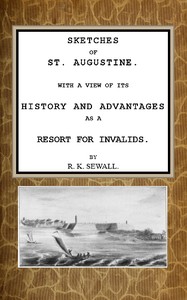
Sketches of St. Augustine With a view of its history and advantages as a resort for invalids — Key Ideas to Explore can be approached with a clearer sense of reading commitment from its source measurements: 18,739 words, 1 hr 22 min estimated reading time, and 3 detected text sections.
The text analysis averages about 20.6 words per sentence, while the detected sections provide another way to judge how the source is divided.
Project Gutenberg metadata also associates the work with “Saint Augustine (Fla.) -- History,” connecting these edition facts with the source record’s subject description.
Explore this collection
These alternatives are selected using recorded categories and estimated reading time.
About 60 minutes
Places Peoples
13,797 recorded words. 22 minutes difference from this book's estimate.
View Gutenberg source #50894About 174 minutes
Places Peoples
39,916 recorded words. 92 minutes difference from this book's estimate.
View Gutenberg source #52706About 199 minutes
Places Peoples
45,744 recorded words. 117 minutes difference from this book's estimate.
View Gutenberg source #52625Search stored excerpts and compare books → Choose by your preferences →
Choices use stored catalog measurements. Estimates vary with reading speed. A shared category is a catalog label, not a claim that two books have the same argument or literary quality.
Search reads excerpt text stored with this catalog and links to its associated Gutenberg record. The connection is stored in the site database; this tool does not recheck that every excerpt is word-for-word identical to that external record. Excerpt search does not cover every chapter and does not verify historical publication dates.
Catalog snapshot checked: 2026-09-26. Coverage: 100 public books, 100 available source excerpts.
Calculated from edition completeness, EPUB availability, text structure and catalogue metadata. Not a user rating.
Total of 100 points, scaled to a 2.5-5.0 range. Editions with an empty description or a missing EPUB file are not scored.
Public-domain source text
The source text is kept in the dedicated reader, separate from this catalogue record and its commentary.
Sewall opens his 1848 guide by positioning St. Augustine as a place where history and health converge. He writes that the work is “a glimpse at, rather than a full history,” yet it promises a “connected view of the course of events” for the sojourner. The author’s stated audience is twofold: those curious about the town and those “who may already have come hither in search of health.” This dual purpose shapes the entire text, which moves between chronicling Spanish colonial episodes and cataloging the climatic advantages of the Florida coast.
The excerpts reveal a writer who is both booster and historian. Sewall’s tone shifts from the dry recitation of founding dates to a dramatic, almost novelistic account of a Methodist minister facing down a spectral Pope—a story he uses to illustrate the change from Spanish Catholic rule to American religious liberty. The guide is thus a hybrid document: part travelogue, part promotional pamphlet, part local legend collection.
Sewall traces St. Augustine’s history through a series of violent transitions. He recounts the massacre of Huguenot Protestants, Drake’s attack, an Indian assault, and the “contribution laid on the city by Davis, the Bucanier.” The list of depredations is almost rhythmic: Spanish, French, English, buccaneers, and finally American control. Each change of flag is marked by bloodshed or extortion.
The author’s most vivid historical anecdote involves a Methodist preacher who, after the U.S. takeover, is confronted by a “wrathy shadow of the Pope.” The itinerant minister points to the “stars and stripes” flying over the Castillo de San Marcos, and the apparition vanishes. Sewall calls this “the first time that prelacy had been taught a lesson of forbearance here.” The story is less about religious history than about the symbolic power of a new national flag—a flag that Sewall, writing in 1848, clearly sees as a guarantor of freedom.
Yet the guide does not dwell on the Spanish period with nostalgia. Sewall treats the colonial past as a series of episodes that culminate in American rule, which he presents as both inevitable and beneficial. The reader is left with a sense of a place repeatedly conquered and rebuilt, its identity layered like the coquina stone of its fort.
One of the most striking passages in the excerpts describes the destruction of St. Augustine’s orange groves in February 1835. Sewall writes that before that night, the city “was one immense orange orchard,” with white houses “peeping from among the clustered boughs and golden fruit.” The harbor was crowded with fruit vessels; the annual export reached between two and three million oranges. Then a single frost “cut down the entire species of the orange tribe, some of the trees rivaling in stature the sturdy forest oak.”
Sewall’s language here is almost biblical: “At one fell stroke, the labor and profit of years of toil—the inheritance of many generations—the little all of many families, were swept away!” He notes that the city had not recovered by 1848, and that young shoots were being destroyed by “insignificant animalculæ.” The passage is notable for its shift from boosterism to elegy. The orange groves were not just an economic asset; they were the city’s identity. Their loss, Sewall implies, is a wound that may never fully heal.
This section of the guide serves as a cautionary tale about the fragility of agricultural economies. It also reveals Sewall’s skill at weaving statistical detail—$72,000 annual income, 6,000 oranges per tree—into a narrative of decline.
The third chapter of the guide is devoted entirely to Florida’s climate, which Sewall promotes as a remedy for “consumptive habits” and other northern ailments. He includes “tables of temperature” comparing St. Augustine to foreign resorts, and cites the testimony of physicians. The coast climate, he argues, is especially beneficial for invalids. The language is clinical but also promotional: the air is “genial,” the location “healthy.”
Sewall’s target audience is clear: those “disposed to seek other and more congenial latitudes” due to health concerns. He mentions the St. Lucie River and Sound, where “the banks are high shell bluff, and exceedingly fertile.” The guide thus functions as a piece of medical geography, mapping the conditions that might restore a weakened constitution.
Yet the climate section is not entirely optimistic. The frost of 1835 hangs over the entire book, a reminder that even the mildest climate can turn deadly. Sewall’s promotion of St. Augustine as a health resort is tempered by the knowledge that nature is not always benign. The reader is left to weigh the promise of recovery against the memory of a single night that destroyed an entire industry.
Sewall’s guide is best read as a document of its moment—1848, just thirteen years after the great frost, when St. Augustine was still reeling from economic collapse. The author’s enthusiasm for the climate is genuine, but it is shadowed by the loss of the orange groves. Readers interested in the history of Florida tourism, antebellum health culture, or the literary construction of place will find here a compact, revealing text. Pay attention to the shifts in tone: from the dry recitation of historical events to the almost novelistic anecdote of the ghostly Pope, from boosterish statistics to elegiac descriptions of a vanished orchard. These contrasts are the book’s true subject.
There’s something tender in old guidebooks, the way they assume the world will stay put. Reading Sewall’s St. Augustine, I felt that warmth—the frost killing the oranges, the preacher facing a ghost. It reminded me of another journey, quieter still, in Nine Thousand Miles on a Pullman Train An Account of a Tour of Railroad Conductors from Philadelphia to the Pacific Coast and Return — Key Ideas to Explore. Both are just people noting what they saw, hoping it matters.
Save your reaction, strongest insight, and memorable passage.
![Cover of Washington, its sights and insights [1909] — Text and Context](https://wuuak.com/storage/media/covers/pg52202.jpg)