About 311 minutes
The Magic of Spain — Edition Insights
Places Peoples
71,438 recorded words. 24 minutes difference from this book's estimate.
View Gutenberg source #53001
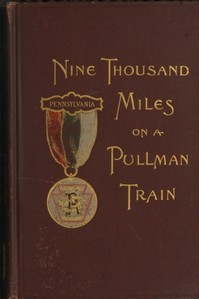
The catalog record for Nine Thousand Miles on a Pullman Train An Account of a Tour of Railroad Conductors from Philadelphia to the Pacific Coast and Return — Key Ideas to Explore provides practical reading context through 66,005 words, 4 hr 47 min estimated reading time, and 10 detected text sections.
The text analysis averages about 18.9 words per sentence, while the detected sections provide another way to judge how the source is divided.
Project Gutenberg metadata also associates the work with “United States -- Description and travel,” connecting these edition facts with the source record’s subject description.
Explore this collection
These alternatives are selected using recorded categories and estimated reading time.
About 311 minutes
Places Peoples
71,438 recorded words. 24 minutes difference from this book's estimate.
View Gutenberg source #53001About 213 minutes
Places Peoples
48,812 recorded words. 74 minutes difference from this book's estimate.
View Gutenberg source #52202About 199 minutes
Places Peoples
45,744 recorded words. 88 minutes difference from this book's estimate.
View Gutenberg source #52625Search stored excerpts and compare books → Choose by your preferences →
Choices use stored catalog measurements. Estimates vary with reading speed. A shared category is a catalog label, not a claim that two books have the same argument or literary quality.
Search reads excerpt text stored with this catalog and links to its associated Gutenberg record. The connection is stored in the site database; this tool does not recheck that every excerpt is word-for-word identical to that external record. Excerpt search does not cover every chapter and does not verify historical publication dates.
Catalog snapshot checked: 2026-09-26. Coverage: 100 public books, 100 available source excerpts.
Calculated from edition completeness, EPUB availability, text structure and catalogue metadata. Not a user rating.
Total of 100 points, scaled to a 2.5-5.0 range. Editions with an empty description or a missing EPUB file are not scored.
Public-domain source text
The source text is kept in the dedicated reader, separate from this catalogue record and its commentary.
M. M. Shaw's Nine Thousand Miles on a Pullman Train (1898) documents a tour of railroad conductors from Philadelphia to the Pacific Coast and back. The narrative is driven by Shaw's persistent habit of recording engine numbers, crew names, and operational details—a practice that sets the book apart from typical travelogues. For example, he notes engine 1793 with Engineer J. Edwards on the Portland Flyer, and later engine 1769 with Engineer J. Clark and Conductor G. E. Morgan. This technical curiosity coexists with descriptive passages about landscapes, towns, and natural wonders, such as the Sacramento River's “leaping, tumultuous waters.” The catalog subjects—United States description and travel, and railroad travel—are accurate but incomplete; the book is as much about the machinery and organization of rail travel as about the scenery.
Shaw's narrative is structured like a logbook, with each day's entry beginning with the date and often the time. He consistently asks conductors for engine numbers, crew names, and route details, as when he queries Conductor Morgan: “Where did you take charge of our train, please, and what is the number of your engine and the names of your crew?” This methodical recording gives the text a documentary quality. The excerpts show that Shaw treats the train itself as a subject: he describes the ferryboat “Salina” as “the largest ferryboat ever constructed, being 424 feet long, 116 feet wide, and 18 feet deep,” and notes the transition from coal to wood fuel. This attention to infrastructure aligns with the catalog subject “Railroad travel,” but the book goes beyond passenger experience to include the perspective of railroad employees.
Shaw's descriptions of scenery are often framed by the train's movement. He writes of “watching the fleeting, ever-varying landscape” and notes the regret when darkness falls. The Sacramento River is described as “a large surging, gurgling, dashing stream” that the train crosses eighteen times. At Redding, he observes the river on one side and the town on the other, creating a sense of motion. The catalog subject “United States -- Description and travel” is evident, but the excerpts reveal that Shaw's gaze is selective: he focuses on rivers, mountains, and towns that are visible from the rail line, and he often includes practical details like distances (“260 miles from San Francisco and over 500 from Portland”). This is not a comprehensive geography but a route-specific account.
Although the excerpts are limited, they hint at a social dimension. Shaw mentions “Brother R. L. Myers” and “Brothers Maxwell, Reagan, Waddington,” suggesting a fraternal organization among the conductors. He also records courtesies shown by members of Boards of Trade. The dedication “To the true and loyal women of our party, the beloved and cherished companions of our hearths and homes” indicates that women accompanied the group, though their role is not elaborated in the excerpts. The book's list of illustrations includes portraits of committee members and local figures like “Tom McDonald and Fred Beach” and “Myrtle Taylor on a Bronco.” These elements suggest a communal travel experience, but the excerpts do not reveal the full dynamics of the party.
Readers should approach this book as a hybrid document: part travelogue, part technical record, and part social chronicle of a specific professional group in 1898. Shaw's habit of naming every crew member and engine gives the narrative a concrete, almost archival quality. The excerpts do not cover the entire journey, so the book may contain additional patterns—such as interactions with local communities or reflections on the railroad industry—that are not visible here. Pay attention to how Shaw balances his dual interests in machinery and landscape, and note the gaps where the catalog subjects oversimplify the work's content.
I caught myself thinking of my grandfather’s logbook, where he noted every engine number like a prayer. This tour felt that way—an honest recording, not romance. It reminded me of reading Frank's Ranche; Or, My Holiday in the Rockies Being a Contribution to the Inquiry into What We Are to Do with Our Boys — Story, Setting & Ideas, where the wildness was also just a place to breathe, quietly.
Your answers remain private and are stored only in this browser.
![Cover of Washington, its sights and insights [1909] — Text and Context](https://wuuak.com/storage/media/covers/pg52202.jpg)