About 213 minutes
Washington, its sights and insights [1909] — Text and Context
Places Peoples
48,812 recorded words. 14 minutes difference from this book's estimate.
View Gutenberg source #52202
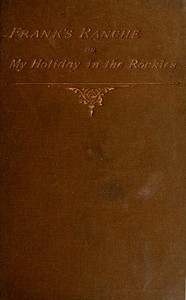
The catalog record for Frank's Ranche; Or, My Holiday in the Rockies Being a Contribution to the Inquiry into What We Are to Do with Our Boys — Story, Setting & Ideas provides practical reading context through 45,744 words, 3 hr 19 min estimated reading time, and 12 detected text sections.
The text analysis averages about 23.4 words per sentence, while the detected sections provide another way to judge how the source is divided.
Project Gutenberg metadata also associates the work with “Rocky Mountains -- Description and travel,” connecting these edition facts with the source record’s subject description.
Explore this collection
These alternatives are selected using recorded categories and estimated reading time.
About 213 minutes
Places Peoples
48,812 recorded words. 14 minutes difference from this book's estimate.
View Gutenberg source #52202About 174 minutes
Places Peoples
39,916 recorded words. 25 minutes difference from this book's estimate.
View Gutenberg source #52706About 287 minutes
Places Peoples
66,005 recorded words. 88 minutes difference from this book's estimate.
View Gutenberg source #51341Search stored excerpts and compare books → Choose by your preferences →
Choices use stored catalog measurements. Estimates vary with reading speed. A shared category is a catalog label, not a claim that two books have the same argument or literary quality.
Search reads excerpt text stored with this catalog and links to its associated Gutenberg record. The connection is stored in the site database; this tool does not recheck that every excerpt is word-for-word identical to that external record. Excerpt search does not cover every chapter and does not verify historical publication dates.
Catalog snapshot checked: 2026-09-26. Coverage: 100 public books, 100 available source excerpts.
Calculated from edition completeness, EPUB availability, text structure and catalogue metadata. Not a user rating.
Total of 100 points, scaled to a 2.5-5.0 range. Editions with an empty description or a missing EPUB file are not scored.
Public-domain source text
The source text is kept in the dedicated reader, separate from this catalogue record and its commentary.
Edward Marston's Frank's Ranche; Or, My Holiday in the Rockies (1885) is presented as a contribution to the question "What We Are to Do with Our Boys," yet the excerpts focus overwhelmingly on the author's travel experiences rather than educational theory. The dedicatory letter reveals that the journey was undertaken with a friend, M., who insisted on the best accommodations and whose "warmhearted friendship for Frank" prompted them to "rough it" in a log shanty. This tension between comfort and adventure sets the tone for a narrative that is part personal holiday, part social commentary.
Marston opens with an epigraph from Cowley urging readers to "steal one day out of thy life, to live," and then immediately undercuts his own authority in the Introductory Note. Citing Oliver Wendell Holmes, he admits he has no shipwreck, battle, or bear-hug to report, and cannot claim to tell anything new. This rhetorical humility frames the book as a modest record rather than a grand adventure, yet the excerpts that follow—descriptions of boiling cauldrons and geysers—contradict that modesty. The author's self-deprecation may be a conventional pose, but it also signals that the work's value lies in its observational detail rather than plot or heroism.
The most striking passages in the excerpts describe the geothermal features of Yellowstone. Marston compares the crust over a boiling lake to an "immense honeycomb" and worries it might collapse under the coach. He recounts a wild duck sucked into a cauldron and shot out cooked, a story attributed to the coachman. The geyser "Old Faithful" is noted for its punctuality—rising every sixty-five minutes—and Marston describes its eruption as a column of boiling water "six feet in diameter" rising "a hundred and fifty feet or more" before spreading into a "beautiful vase-like shape." These details are precise and sensory, grounding the narrative in firsthand observation.
The book's subtitle promises a "contribution to the inquiry into what we are to do with our boys," yet the excerpts contain no direct discussion of education, emigration, or youth. The only hint of this theme is the dedicatory letter's mention of Frank and the log shanty. The catalog subject "Rocky Mountains—Description and travel" is accurate, but the secondary topic of boys' futures remains largely implicit. Readers expecting a practical manual may be surprised; instead, the text offers a travelogue punctuated by moments of sublime danger and humor. The disconnect between the subtitle and the content suggests that the inquiry is conducted through example rather than argument.
Readers approaching Frank's Ranche should set aside expectations of a systematic treatise on boyhood. The book rewards those interested in late-Victorian travel writing, particularly the intersection of personal anecdote and natural description. Marston's voice is genial and observant, and his willingness to quote other travelers—like Lord Dunraven—adds depth. Focus on the landscapes and the author's reactions; the subtitle's promise may be fulfilled only in the spaces between the lines.
I keep thinking about that old travelogue through the Rockies, how a trip became a quiet argument for giving boys somewhere real to grow. It stayed with me like a half-remembered sunset. Then The Magic of Spain — Edition Insights arrived, and I felt that same tug—land shaping a person, not just scenery passing by. Such a gentle reminder of how place can settle into us.
Answer a few questions and save a private reflection on this device.
![Cover of Washington, its sights and insights [1909] — Text and Context](https://wuuak.com/storage/media/covers/pg52202.jpg)