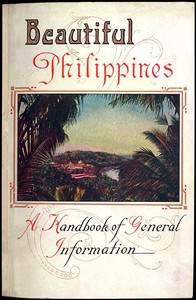
The handbook opens with a detailed table of contents that immediately signals its dual purpose: to inform and to advocate. Structured into chapters on history, population, geography, and industry, it moves from a chronological account of Spanish and American rule to a survey of natural resources and manufactured goods. The prose alternates between factual enumeration—such as the number of islands (7,083) and land area (114,400 square miles)—and persuasive passages that counter perceived misrepresentations of the Philippines. This tension between objective data and promotional intent shapes the entire work.
Movement from Historical Narrative to Economic Survey
The book’s structure reveals a deliberate progression. The early chapters recount the Spanish period, the Philippine Republic, and the establishment of civil government, often citing foreign observers to bolster credibility. After this historical foundation, the focus shifts abruptly to geography and then to detailed descriptions of Manila, other cities, and provinces. The later chapters on agriculture, forestry, and manufacturing read like an industrial prospectus. For instance, the section on Manila cigars includes a table of export figures from 1913 to 1922, showing both number and value of cigars, and notes that the government guarantees production standards. This movement from past to present, from narrative to data, suggests the handbook was designed to equip readers with both context and concrete evidence of economic potential.
Recurring Emphasis on Regulation and Quality Control
Throughout the economic sections, a recurring motif is the role of government oversight in ensuring product quality. The cigar industry receives particular attention: the text specifies that cigars must be made from tobacco from three provinces, that no cigars made between sunset and sunrise may be graded as standard, and that government inspectors can condemn substandard lots. Similar language appears in discussions of other exports, such as sugar and copra, where grading standards and inspection procedures are highlighted. This emphasis on regulation serves to counter any assumption that Philippine products are inferior, framing government intervention as a guarantee of excellence rather than a bureaucratic burden.
Geographic Description as Inventory
The chapters on geography and provinces read less like travel writing and more like an inventory of natural assets. Bays, straits, mountains, rivers, lakes, and mineral springs are listed with measurements and locations. For example, the text notes that the archipelago has “many fine bays and straits” and enumerates specific peaks like Mount Mayon and Mount Apo. The climate section provides rainfall data and comparative areas. This cataloging approach extends to the provincial descriptions, where each area is introduced with its principal products—Laguna for its falls and mineral springs, Rizal for its proximity to Manila. The effect is to present the entire country as a collection of resources awaiting development, a perspective consistent with the handbook’s promotional purpose.
Visual and Statistical Presentation of Data
The handbook incorporates tables and lists that break the flow of prose, offering readers quick reference points. The cigar export table is one example; another is a list of “other food crops” that includes sweet potatoes, cassava, sesame, mongoes, peanuts, bananas, mangoes, citrus, lanzones, and “a great number of tropical fruits and vegetables.” The text also states that “more than 100 species of plants” are used in the Filipino diet. These enumerations serve to demonstrate abundance and variety. The use of statistics—such as the 1918 corn acreage of 1,035,067 acres producing 11,269,258 bushels—grounds the promotional claims in numbers, lending an air of authority. However, the absence of maps or illustrations in the excerpts suggests that the handbook relied primarily on textual description and tabular data to convey its information.
Readers approaching this handbook should recognize it as a document of its time—a work that blends factual reporting with advocacy for Philippine independence and economic development. The structure, moving from history to geography to industry, reflects a strategic effort to present the islands as both civilized and resource-rich. The recurring focus on government regulation and quality control reveals an anxiety about international perceptions. For those interested in early 20th-century Philippine history or the rhetoric of colonial development, this handbook offers a rich primary source, provided its promotional context is kept in view.
There’s something oddly touching about a century-old handbook that believed so firmly in progress. Reading its careful lists of resources and industries, I felt the weight of that optimism, its specific, hopeful voice. It made me think of Sketches in Egypt — Text and Context—another place captured in its own moment, equally earnest, equally unaware of how we’d look back on it.