About 297 minutes
Walks about Washington — Edition Insights
Geography
68,231 recorded words. 2 minutes difference from this book's estimate.
View Gutenberg source #56104
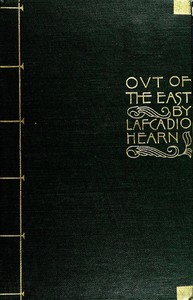
"Out of the East": Reveries and Studies in New Japan — Themes and Context can be approached with a clearer sense of reading commitment from its source measurements: 67,729 words, 4 hr 55 min estimated reading time, and 7 detected text sections.
The text analysis averages about 20.5 words per sentence, while the detected sections provide another way to judge how the source is divided.
Project Gutenberg metadata also associates the work with “Japan -- Description and travel,” connecting these edition facts with the source record’s subject description.
Explore this collection
These alternatives are selected using recorded categories and estimated reading time.
About 297 minutes
Geography
68,231 recorded words. 2 minutes difference from this book's estimate.
View Gutenberg source #56104About 302 minutes
Geography
69,301 recorded words. 7 minutes difference from this book's estimate.
View Gutenberg source #61087About 287 minutes
Geography
65,869 recorded words. 8 minutes difference from this book's estimate.
View Gutenberg source #61774Search stored excerpts and compare books → Choose by your preferences →
Choices use stored catalog measurements. Estimates vary with reading speed. A shared category is a catalog label, not a claim that two books have the same argument or literary quality.
Search reads excerpt text stored with this catalog and links to its associated Gutenberg record. The connection is stored in the site database; this tool does not recheck that every excerpt is word-for-word identical to that external record. Excerpt search does not cover every chapter and does not verify historical publication dates.
Catalog snapshot checked: 2026-09-26. Coverage: 100 public books, 100 available source excerpts.
Calculated from edition completeness, EPUB availability, text structure and catalogue metadata. Not a user rating.
Total of 100 points, scaled to a 2.5-5.0 range. Editions with an empty description or a missing EPUB file are not scored.
Public-domain source text
The source text is kept in the dedicated reader, separate from this catalogue record and its commentary.
The book opens with Hearn luxuriating in a Japanese inn after escaping a Western-style hotel, describing the experience as 'a redemption from all the sorrows of the nineteenth century.' He notes the bamboo shoots and lotus bulbs served for breakfast, and a fan depicting a wave and sea-birds that makes him 'want to shout.' The inn is called the House of Urashima, linking his stay to the Japanese folktale of a fisherman who visits an undersea palace and returns to find centuries have passed.
The first essay, 'The Dream of a Summer Day,' establishes a pattern of sensory immersion followed by philosophical turn. Hearn's initial delight in the inn's beauty—the 'cool, soft matting,' the 'sweet-voiced girls,' the view of 'yellow lazy junks asleep at anchor'—is interrupted by the inn's mistress, whose appearance makes him 'think at once of death.' This pivot from pleasure to mortality recurs throughout the collection. The title itself hints at the transient nature of the experiences he records.
In a later passage, Hearn directly addresses Buddhist teachings, quoting the Buddha: 'Be ye lamps unto yourselves; be ye a refuge unto yourselves.' He contrasts this with Western faith, which he predicts will 'pass away forever,' leaving humanity to face 'the terrible truth of existence' without divine aid. This section reveals Hearn's engagement with Eastern philosophy as a serious alternative to the Christianity of his upbringing. He warns that science may reveal even darker truths, such as the endless cycle of death and rebirth driven by 'insatiable desire.'
The essay 'Jiujutsu' opens with a description of a building in a government college grounds: the Zuihōkwan, or 'Hall of Our Holy Country.' Unlike other structures, it is purely Japanese in style, with a single large room cushioned by one hundred mats. Inside hang two pictures: one of the 'White-Tiger Band'—seventeen boys who died for loyalty in a civil war—and a portrait of a beloved professor of Chinese. Hearn uses this setting to introduce the martial art of jiujutsu, linking its principles of suppleness and weakness to the Taoist text Tao-Te-King.
Across the excerpts, Hearn employs a consistent method: he begins with a vivid, often sensual description of a place or custom, then moves to a broader cultural or philosophical meditation. The opening essay's fan, the inn's name, and the later references to Buddhist and Taoist texts all serve as entry points into deeper reflection. The collection's subtitle, 'Reveries and Studies,' accurately captures this blend of personal impression and analytical observation. Readers should expect each piece to shift from the concrete to the abstract, often without explicit transition.
Hearn's essays reward attention to his descriptive precision—the 'cedarn balcony pillars,' the 'white rushing burst' of a wave on a fan—as well as his willingness to let a scene dissolve into speculation. The excerpts suggest that the book's unity lies less in narrative continuity than in a persistent questioning of modernity, tradition, and belief. A first-time reader may find it useful to treat each essay as a self-contained meditation, noting how Hearn's initial impressions give way to larger arguments about Japan and the human condition.
I finished Hearn’s reveries and kept thinking about how a place can hold you differently than its history suggests—like stillness at a seaside inn. That same quiet ache came back reading The Land Beyond the Forest: Facts, Figures, and Fancies from Transylvania — Story, Setting & Ideas, where the land speaks in whispers under grander stories. Both left me softer, somehow, to the unfamiliar.
Use these questions to collect your thoughts before moving on.









