About 287 minutes
Beautiful Philippines: A Handbook of General Information — Reading Notes
Geography
65,869 recorded words. 6 minutes difference from this book's estimate.
View Gutenberg source #61774
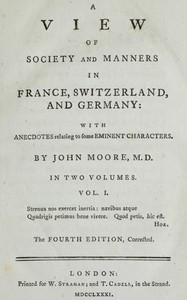
The source record for A View of Society and Manners in France, Switzerland, and Germany, Vol. 1 (of 2) With Anecdotes Relating to Some Eminent Characters — Themes and Context measures this digital text at 64,603 words, 4 hr 41 min estimated reading time, and 8 detected text sections.
The text analysis averages about 27.3 words per sentence, while the detected sections provide another way to judge how the source is divided.
Project Gutenberg metadata also associates the work with “Europe -- Description and travel -- Early works to 1800,” connecting these edition facts with the source record’s subject description.
Explore this collection
These alternatives are selected using recorded categories and estimated reading time.
About 287 minutes
Geography
65,869 recorded words. 6 minutes difference from this book's estimate.
View Gutenberg source #61774About 272 minutes
Geography
62,503 recorded words. 9 minutes difference from this book's estimate.
View Gutenberg source #58764About 295 minutes
Geography
67,729 recorded words. 14 minutes difference from this book's estimate.
View Gutenberg source #55802Search stored excerpts and compare books → Choose by your preferences →
Choices use stored catalog measurements. Estimates vary with reading speed. A shared category is a catalog label, not a claim that two books have the same argument or literary quality.
Search reads excerpt text stored with this catalog and links to its associated Gutenberg record. The connection is stored in the site database; this tool does not recheck that every excerpt is word-for-word identical to that external record. Excerpt search does not cover every chapter and does not verify historical publication dates.
Catalog snapshot checked: 2026-09-26. Coverage: 100 public books, 100 available source excerpts.
Calculated from edition completeness, EPUB availability, text structure and catalogue metadata. Not a user rating.
Total of 100 points, scaled to a 2.5-5.0 range. Editions with an empty description or a missing EPUB file are not scored.
Public-domain source text
The source text is kept in the dedicated reader, separate from this catalogue record and its commentary.
John Moore's A View of Society and Manners in France, Switzerland, and Germany (1779) opens with an unusual confession: the author originally disguised his first two letters as fiction, only to restore them after friends warned the ruse would undermine the work's credibility. This editorial note sets the tone for a travel narrative that is as much about the observer's voice as the observed scenes. Moore, a Scottish physician and novelist, writes with a conversational ease that often slides into dry humor, as when he reports the debate over whether glaciers are growing—a dispute he declines to settle, noting that the timid may "dismiss their fears" of the world becoming an appendage to Mont Blanc.
Moore's narrative persona is that of a genial but skeptical observer, quick to note contradictions and local beliefs without endorsing them. In Chamouni, he records the theory that glaciers are expanding, but undercuts it with a wry aside: the inhabitants may be biased because the glaciers now attract tourists. He then reports a counter-argument that leads to an absurdity—the globe becoming an appendage to Mont Blanc—and lets the locals reply that the world will end before that happens. Moore steps back: "For my own part, though I wish well to the Glaciers... I will take no part in this controversy." This refusal to adjudicate is characteristic; he prefers to present competing views and let the reader judge.
One of the most striking passages in the excerpts is a conversation with an elderly former soldier in the king of Sardinia's service. Moore asks whether an idiot girl he saw is unhappy; the soldier replies that such people are "très heureux." When Moore presses—would he have liked to be born that way?—the soldier answers, "Pour cela, non, Monsieur; je n'aurois jamais travaillé." Moore then reflects that a man who has labored hard all his life sees idleness as the greatest blessing, while someone raised in indolent luxury might think differently. The exchange is a miniature essay on perspective, delivered through dialogue rather than abstraction.
The work's structure as a series of letters allows Moore to shift pace abruptly: from a philosophical aside on glaciers to a village anecdote, then to a remark on goiters in certain regions. The excerpts show a rhythm of observation, reflection, and dry commentary. The letter from Geneva, for instance, moves from a morning sighting of an idiot girl to a sustained dialogue, then to a general remark about the prevalence of idiocy in the valley—all within a few paragraphs. This episodic quality mirrors the traveler's experience, where moments of stillness (a girl sitting before a door) give way to conversation and then to broader speculation.
Readers approaching this volume should attend to Moore's tone: he is neither a sentimentalist nor a mere fact-gatherer. His humor often emerges in the gap between what he reports and how he reports it. The epistolary form rewards those who read for voice as much as for information. The second volume continues the journey into Germany, but the first establishes a method of travel writing that is both observational and self-aware.
Reading Moore’s glacial detachment, I recalled my own fleeting glimpse of a glacier in Switzerland—how silence hummed there, oddly akin to the vast, grassy quiet my grandfather described from his wagon trip west. The Western Echo A Description of the Western State and Territories of the United States. As Gathered in a Tour by Wagon — Key Ideas to Explore held that same patient awe, the land speaking slowly, and me, just listening.
Answer a few questions and save a private reflection on this device.









