
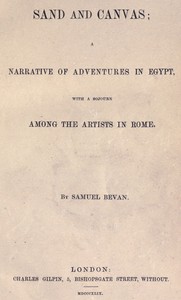
Sand and Canvas: Narrative of adventures in Egypt with a sojourn among the artists in Rome — Story, Setting & Ideas

(0 User reviews)   909
In Category - Geography
Bevan, Samuel Project Gutenberg 2022 Not confirmed
Italy -- Description and travel; Egypt -- Description and travel Readers of public-domain and historical texts
Project Gutenberg digital edition en

Edition facts

Words 86,156
Reading time 375 min
Text sections 32

This digital edition of Sand and Canvas: Narrative of adventures in Egypt with a sojourn among the artists in Rome — Story, Setting & Ideas is described by source-level measurements including 86,156 words, 6 hr 15 min estimated reading time, and 32 detected text sections.

The text analysis averages about 34.1 words per sentence, while the detected sections provide another way to judge how the source is divided.

Project Gutenberg metadata also associates the work with “Italy -- Description and travel,” connecting these edition facts with the source record’s subject description.

Explore this collection

Compare your next read

These alternatives are selected using recorded categories and estimated reading time.

Search stored excerpts and compare books → Choose by your preferences →

How these choices and excerpts are prepared

Choices use stored catalog measurements. Estimates vary with reading speed. A shared category is a catalog label, not a claim that two books have the same argument or literary quality.

Search reads excerpt text stored with this catalog and links to its associated Gutenberg record. The connection is stored in the site database; this tool does not recheck that every excerpt is word-for-word identical to that external record. Excerpt search does not cover every chapter and does not verify historical publication dates.

Catalog snapshot checked: 2026-09-26. Coverage: 100 public books, 100 available source excerpts.

Samuel Bevan's 1849 travelogue, drawn from a diary, recounts his unexpected journey from London to Egypt and Rome, focusing on modern art and everyday encounters rather than famous monuments.
Share
Editorial Edition Score 4.9/5

Calculated from edition completeness, EPUB availability, text structure and catalogue metadata. Not a user rating.

How this score is calculated
  • Description quality20 pts
  • Title & short description10 pts
  • Source metadata20 pts
  • Text length15 pts
  • Chapters / structure15 pts
  • EPUB file integrity20 pts

Total of 100 points, scaled to a 2.5-5.0 range. Editions with an empty description or a missing EPUB file are not scored.

Edition quality

Public-domain source text

Read the source text

The source text is kept in the dedicated reader, separate from this catalogue record and its commentary.

Samuel Bevan's Sand and Canvas opens with a preface that sets it apart from conventional travel narratives. The author explains that his diary was kept not for publication but from habit, and that he was transplanted from London's yellow fogs to the desert by a singular chain of circumstances. He deliberately avoids elaborate descriptions of churches, temples, and palaces, offering instead a simple narrative of adventures and a focus on modern art and its votaries. The title itself—Sand and Canvas—signals the dual focus on Egypt and the artist community in Rome.

A Diary's Unpretentious Origins

The preface reveals Bevan's method: daily incidents were noted down without initial intent to publish. He claims this practice, if not instructive, is sure to repay the little trouble it occasions. This self-deprecating tone frames the entire work as a personal record rather than a comprehensive guide. The reader is warned not to expect rhapsodies over prospects or parades of opinions on art. Instead, the narrative will be a relation of experiences that might present something new, even on well-trodden countries. This modest framing invites the reader to treat the text as a candid, unvarnished account.

Vivid Encounters in the Field

In the excerpt from the Italian journey, Bevan's observational eye is sharp. He describes the Grotto del Cane, where a dog is subjected to a cruel infliction of gas, yet the animal sneezes and kicks itself back into life in the most good-humoured way. The scene is rendered with dry humor: the dog runs away with a big bit of bread to keep up his spirits. Bevan also notes the ground alive with small frogs, jumping by hundreds at every foot-fall, thriving on noxious vapours. Such details ground the narrative in specific, tangible moments rather than abstract impressions.

The Texture of Travel: Ruins and Ruffians

Bevan's account of Pozzuoli blends historical observation with immediate annoyance. He notes the ruins of the city visible beneath the blue water, and the remains of an amphitheatre of prodigious dimensions. Yet the carriage is besieged by a clamorous posse of young ruffians laden with antiques, both genuine and modern, who clamber upon the steps and wheels. The coachman's whip is the only argument they listen to. This juxtaposition of ancient grandeur and present-day nuisance is characteristic of Bevan's style: he does not ignore the gritty realities of travel.

Artists and the Unseen

The preface promises a focus on modern Art and its numerous votaries, and the excerpt hints at this through encounters with artists. At the Grotto of the Sybil, a party of fair country-women emerge from underground, having been splashed about in the brawny grasp of uncouth ruffians, stifled with smoke of torches. They report having seen nothing, and Bevan and his companions wisely avoid the expedition. This anecdote underscores the gap between expectation and experience, a theme that likely runs through the Roman sojourn. The reader is left curious about the artist community Bevan will describe.

Bevan's narrative rewards readers who appreciate concrete detail over grand pronouncements. The diary format lends immediacy, while the author's wry observations—on dogs, frogs, and pushy vendors—keep the text grounded. Approach Sand and Canvas as a series of sketches rather than a systematic travelogue; its value lies in the specific, often humorous moments that reveal the texture of mid-19th-century travel.

Flicking through Sand and Canvas, I was struck by how Bevan lingered on the small, unglamorous moments of his journey—the dusty roads, the ordinary conversations. It reminded me of another quiet book, The Newmarket, Bury, Thetford and Cromer Road Sport and history on an East Anglian turnpike — Background and Themes, which finds the same gentle poetry in a forgotten turnpike’s everyday traffic. Both prefer the path’s texture to its destination.

There are no reviews for this eBook.

0
0 out of 5 (0 User reviews )

Add a Review

Your Rating *
There are no comments for this eBook.

Reader reflection

What did you think of this book?

Answer a few questions and save a private reflection on this device.

Your progress 0 / 10
1

How far have you progressed with this book?

2

How did the book work for you overall?

3

How likely are you to recommend this book?

4

How much effort did this book require?

Related eBooks









