About 326 minutes
The Cambridge, Ely, and King's Lynn Road: The Great Fenland Highway — Themes and Context
Geography
74,858 recorded words. 2 minutes difference from this book's estimate.
View Gutenberg source #60205
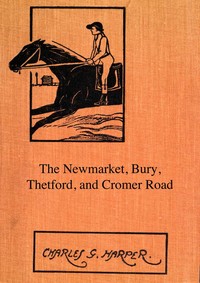
The catalog record for The Newmarket, Bury, Thetford and Cromer Road Sport and history on an East Anglian turnpike — Background and Themes provides practical reading context through 75,415 words, 5 hr 28 min estimated reading time, and 60 detected text sections.
The text analysis averages about 27.8 words per sentence, while the detected sections provide another way to judge how the source is divided.
Project Gutenberg metadata also associates the work with “England -- Description and travel,” connecting these edition facts with the source record’s subject description.
Explore this collection
These alternatives are selected using recorded categories and estimated reading time.
About 326 minutes
Geography
74,858 recorded words. 2 minutes difference from this book's estimate.
View Gutenberg source #60205About 323 minutes
Geography
74,073 recorded words. 5 minutes difference from this book's estimate.
View Gutenberg source #58482About 334 minutes
Geography
76,751 recorded words. 6 minutes difference from this book's estimate.
View Gutenberg source #54974Search stored excerpts and compare books → Choose by your preferences →
Choices use stored catalog measurements. Estimates vary with reading speed. A shared category is a catalog label, not a claim that two books have the same argument or literary quality.
Search reads excerpt text stored with this catalog and links to its associated Gutenberg record. The connection is stored in the site database; this tool does not recheck that every excerpt is word-for-word identical to that external record. Excerpt search does not cover every chapter and does not verify historical publication dates.
Catalog snapshot checked: 2026-09-26. Coverage: 100 public books, 100 available source excerpts.
Calculated from edition completeness, EPUB availability, text structure and catalogue metadata. Not a user rating.
Total of 100 points, scaled to a 2.5-5.0 range. Editions with an empty description or a missing EPUB file are not scored.
Public-domain source text
The source text is kept in the dedicated reader, separate from this catalogue record and its commentary.
Charles G. Harper's account of the road from Newmarket to Cromer is less a straightforward guide than a layered commentary on the landscapes and towns it passes. In the excerpts, Harper devotes considerable space to Bury St. Edmunds, where his tone turns acerbic: he describes the town's respectability as 'incarnated on every flat-faced house-front' and its landscape as 'the very negation of the picturesque.' Such judgments reveal a writer more interested in social character than scenic description.
The catalog subjects—'England -- Description and travel' and 'England -- Social life and customs'—are both present, but the excerpts tilt heavily toward the latter, with Harper's opinions often overriding factual reporting. Readers expecting a neutral itinerary will instead find a personal, sometimes sardonic, travel memoir.
Harper's treatment of Bury St. Edmunds is the most sustained example of his critical voice. He writes that 'one never thoroughly realises the full meaning of the word “respectable” until the acquaintance of Bury St. Edmunds is made.' The word becomes a refrain: respectability 'squats heavily,' 'twinkles' from door-knockers, and even extends to the dead, who lie 'in hopes of a Heaven planned on respectable and exclusive lines.' This is not mere description but a pointed social critique.
Harper extends the judgment to the landscape, calling it 'flat and featureless' and lacking even the 'dropsical, water-logged interest of the Fens.' He quotes Defoe approvingly on the town's gentry and polite conversation, then adds his own verdict: 'How exquisitely fragrant of snobbishness!' The effect is to position Bury as a place where propriety stifles character—a theme that may recur elsewhere in the book, though the excerpts do not confirm it.
Harper leavens his social commentary with coaching stories and historical asides. One anecdote tells of a pedestrian who overtakes a Bury coach and declines a lift because he is 'in a hurry to-day'—a joke that underscores the road's slow pace. Such tales align with the book's subtitle, 'Sport and history on an East Anglian turnpike,' and reflect Harper's background as a chronicler of coaching roads.
Elsewhere, he recounts the Battle of Fornham (1173), where the Earl of Leicester's Flamand mercenaries were routed. The discovery of skeletons arranged in a circle under an ash tree adds a macabre note. Harper also mentions the tradition that the good Duke Humphrey of Gloucester was strangled at St. Saviour's Hospital, though he notes that 'monumental ignorance prevails' among passers-by. These passages show Harper weaving historical events into the road's fabric, even when the evidence is thin.
Harper's eye for built environment is evident in his description of Bury's Northgate Street, where the railway station is built 'in the Jacobean style' and resembles 'some ancient mansion of the Hatfield House type, through whose centre a railway has been driven.' The image is striking: a grand house bisected by a train line. He notes the 'broad roads, with few people in them,' the 'great brick railway bridge,' and the 'roomy houses' that produce 'emptiness and chilly vastness, infinitely uncomfortable and unhomely.'
This sense of scale without life recurs in his mention of the 'Toll-house' inn and the fork to Fornham St. Martin, where the road becomes 'the dullest of roads.' Harper's descriptions often emphasize absence—of people, of interest, of the picturesque. Whether this pattern holds for the entire route is unclear from the excerpts, but it suggests a travel writer more attuned to disappointment than to charm.
Harper inserts himself into the narrative through direct address and personal judgments. The preface, written in verse, sets a tone of wry nostalgia: 'I tell the Tale of the Road, with scraps of gossip and curious lore, / With a laugh, or a sigh, and a tear in the eye for the joys and sorrows of yore.' This self-conscious framing suggests a writer who sees himself as a raconteur rather than a systematic historian.
In the body text, Harper's opinions are unguarded. He calls Bury 'ditchwater-dull' and its citizens ignorant of local history. He mocks the 'proverbial slowness of the Bury coaches.' Yet he also includes precise details—the gold ring found with skeletons, the Jacobean station—that ground his commentary in observation. The result is a hybrid work: part guidebook, part essay, part personal reflection. Readers should expect Harper's personality to color every page.
Harper's road is as much a state of mind as a physical route. Readers will find the most value in his sharp characterizations of towns and his ability to conjure a sense of place through anecdote and opinion. The excerpts suggest that the book rewards those interested in early twentieth-century travel writing and social attitudes, rather than those seeking a neutral or comprehensive guide. Approach it as a period piece, and Harper's prejudices become part of the journey.
I kept thinking about how Harper watched Bury St. Edmunds hold its respectability tight, even as something underneath was quietly fading. That same ache followed me through With Axe and Rope in the New Zealand Alps — Context and Discussion—not the landscape, but the way people cling to order in wild places. It felt like the same shadow, just cast differently.
Your answers remain private and are stored only in this browser.









