About 263 minutes
Letters from Australia — Background and Themes
Geography
60,389 recorded words. 4 minutes difference from this book's estimate.
View Gutenberg source #67536
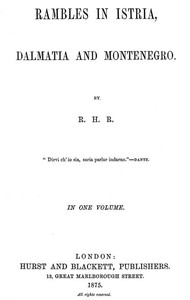
Rambles in Istria, Dalmatia and Montenegro — Reading Notes can be approached with a clearer sense of reading commitment from its source measurements: 59,495 words, 4 hr 19 min estimated reading time, and 8 detected text sections.
The text analysis averages about 34.2 words per sentence, while the detected sections provide another way to judge how the source is divided.
Project Gutenberg metadata also associates the work with “Montenegro -- Description and travel,” connecting these edition facts with the source record’s subject description.
Explore this collection
These alternatives are selected using recorded categories and estimated reading time.
About 263 minutes
Geography
60,389 recorded words. 4 minutes difference from this book's estimate.
View Gutenberg source #67536About 272 minutes
Geography
62,503 recorded words. 13 minutes difference from this book's estimate.
View Gutenberg source #58764About 240 minutes
Geography
55,178 recorded words. 19 minutes difference from this book's estimate.
View Gutenberg source #55859Search stored excerpts and compare books → Choose by your preferences →
Choices use stored catalog measurements. Estimates vary with reading speed. A shared category is a catalog label, not a claim that two books have the same argument or literary quality.
Search reads excerpt text stored with this catalog and links to its associated Gutenberg record. The connection is stored in the site database; this tool does not recheck that every excerpt is word-for-word identical to that external record. Excerpt search does not cover every chapter and does not verify historical publication dates.
Catalog snapshot checked: 2026-09-26. Coverage: 100 public books, 100 available source excerpts.
Calculated from edition completeness, EPUB availability, text structure and catalogue metadata. Not a user rating.
Total of 100 points, scaled to a 2.5-5.0 range. Editions with an empty description or a missing EPUB file are not scored.
Public-domain source text
The source text is kept in the dedicated reader, separate from this catalogue record and its commentary.
The narrative opens not with a departure but with a conversation: the perennial question “Where shall we go to this Summer?” sets the stage for a journey deliberately off the beaten track. R. H. R. frames the account as a practical suggestion for jaded tourists, yet the text quickly reveals a more layered sensibility. The author moves from the grand scale of Vienna’s St. Stephen’s Cathedral to the intimate detail of a café table made of sonorous stone in Cattaro, shifting between historical reflection and immediate sensory experience. This oscillation between the panoramic and the particular defines the work’s structure, as does the recurring motif of movement—by steamer, on foot, through thunderstorms and along the Karst—that mirrors the restless curiosity of the traveller.
The book is built from discrete episodes rather than a continuous itinerary. Chapters are titled by location or event—A Conversation, On the Danube, First View of the Adriatic—and within each the author freely digresses. A description of Pola’s amphitheatre gives way to a note on the band’s lamp arrangement; a conversation with a Montenegrin chief leads to a meditation on the local tobacco. This fragmentary quality is not a flaw but a deliberate reflection of the rambling mode. The reader is invited to follow the author’s associative leaps, from the Roman past to the Austrian present, from the comfort of a café to the rigours of a mountain pass. The structure mirrors the unpredictability of travel itself, where the most memorable moments often arise from chance encounters or unexpected detours.
Three images recur with notable frequency. Stone appears in multiple forms: the Roman amphitheatre at Pola, the “enormously thick slabs” of café tables in Cattaro, the rocky terrain of the Karst. The author is drawn to the materiality of stone, its sound when struck, its endurance through time. Water is ever-present—the Adriatic, the Danube, the subterranean streams of the Karst—and often marks transitions between scenes. Light shifts with the time of day: the “delicious balmy feeling” of twilight in Cattaro, the threat of being “roasted” on Montenegrin rocks at noon. These elements are not merely descriptive; they structure the narrative’s rhythm, providing a sensory anchor amid the constant movement.
The author handles transitions with a deftness that belies the book’s casual tone. A typical shift might begin with a physical action—“Having returned from the opposite side of the water”—then move to a social observation, then to a historical aside, before settling into a new scene. The journey from Trieste to Cattaro, for instance, is not a simple A-to-B account; it includes a flying visit to San Canziano, a thunderstorm, and a digression on the Karst’s wild scenery. These transitions often hinge on a sensory detail: the sound of a band, the taste of coffee, the feel of cooler air from the mountains. By foregrounding the traveller’s immediate experience, the author makes the reader feel the passage from one place to another as a lived, embodied process.
The narrative is populated by a series of interlocutors whose voices break the author’s monologue. There is the Dalmatian who comments on health in India, the Russian consul who introduces the Montenegrin chief Pero Pejovich, and the little beggar boy with “the finest pair of eyes.” These encounters are often brief but vividly rendered, and they serve to anchor the author’s observations in specific human interactions. The author does not claim deep knowledge of these figures; instead, they appear as fleeting presences that enrich the texture of the journey. The most extended dialogue—with Pejovich about the rain in Cattaro—reveals a wry humour and a willingness to let the local voice challenge the traveller’s romanticism. This interplay between the author’s perspective and those he meets gives the book a dialogic quality rare in travel writing of the period.
Readers approaching Rambles in Istria, Dalmatia and Montenegro should expect a work that values the incidental over the systematic. The author’s eye for detail—the shape of a table, the tone of a stone, the look of a beggar boy—makes even the most mundane scene vivid. The book rewards those who read it as a series of impressions rather than a guidebook, and who are willing to follow the author’s digressions with the same curiosity he brings to his travels.
I found myself thinking back on those rambles through Istria’s grey stone towns and Dalmatian shorelines, where every ruined wall seemed to hold a layer of someone’s quiet memory. That same gentle sensation drifted back when I opened Sand and Canvas: Narrative of adventures in Egypt with a sojourn among the artists in Rome — Story, Setting & Ideas, as if the very dust of those old paths had settled onto another page.
Use these questions to collect your thoughts before moving on.









