About 51 minutes
Sketches in Egypt — Text and Context
Geography
11,663 recorded words. 7 minutes difference from this book's estimate.
View Gutenberg source #68568
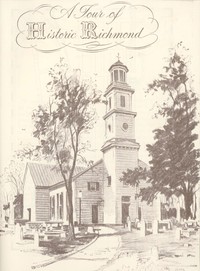
The source record for A Tour of Historic Richmond — Reading Companion measures this digital text at 10,050 words, 44 min estimated reading time, and 2 detected text sections.
The text analysis averages about 21.4 words per sentence, while the detected sections provide another way to judge how the source is divided.
Project Gutenberg metadata also associates the work with “Richmond (Va.) -- Description and travel,” connecting these edition facts with the source record’s subject description.
Explore this collection
These alternatives are selected using recorded categories and estimated reading time.
About 51 minutes
Geography
11,663 recorded words. 7 minutes difference from this book's estimate.
View Gutenberg source #68568About 63 minutes
Geography
14,388 recorded words. 19 minutes difference from this book's estimate.
View Gutenberg source #55576About 71 minutes
Geography
16,119 recorded words. 27 minutes difference from this book's estimate.
View Gutenberg source #67539Search stored excerpts and compare books → Choose by your preferences →
Choices use stored catalog measurements. Estimates vary with reading speed. A shared category is a catalog label, not a claim that two books have the same argument or literary quality.
Search reads excerpt text stored with this catalog and links to its associated Gutenberg record. The connection is stored in the site database; this tool does not recheck that every excerpt is word-for-word identical to that external record. Excerpt search does not cover every chapter and does not verify historical publication dates.
Catalog snapshot checked: 2026-09-26. Coverage: 100 public books, 100 available source excerpts.
Calculated from edition completeness, EPUB availability, text structure and catalogue metadata. Not a user rating.
Total of 100 points, scaled to a 2.5-5.0 range. Editions with an empty description or a missing EPUB file are not scored.
Public-domain source text
The source text is kept in the dedicated reader, separate from this catalogue record and its commentary.
The guide opens with a striking juxtaposition: Richmond is a city where “the rustle of the past may still be heard amid the bustle of the present.” This phrase sets the tone for a work that moves briskly between historical vignettes and practical driving directions. The author, Frances Leigh Williams, organizes the tour as a series of numbered stops, each introduced by a bolded location name. The text alternates between sweeping historical claims—such as Richmond’s role as a “frontier” until 1660—and precise architectural details, like the “oriel window” at Agecroft Hall. The reader is never allowed to forget that this is a physical journey: streets, turns, and landmarks are given in sequence, creating a sense of movement through space and time.
The opening pages trace Richmond’s origins to the falls of the James River, where Captain Newport’s 1607 expedition was blocked by rocks. The author emphasizes that the site was a “frontier post” before William Byrd II founded the town in 1737. The narrative then leaps to the Revolutionary period, highlighting Patrick Henry’s 1775 speech at St. John’s Church and Benedict Arnold’s 1781 occupation. These events are presented as dramatic turning points, but the guide does not linger on any single episode. Instead, it uses them to establish Richmond’s historical density. The reader is told that the city was “hostess” to patriots and later a “thriving center of commerce” during the War of 1812. The effect is cumulative: Richmond emerges as a place where national history repeatedly intersected with local geography.
The tour’s structure is remarkably consistent: each entry begins with a street instruction, such as “proceed left on Kensington to the Boulevard; turn right,” followed by a bolded site name and a paragraph of description. This pattern creates a rhythm that mimics an actual car journey. The directions are precise enough to follow, but they also serve a rhetorical purpose—they anchor the historical commentary in physical space. For example, the approach to Battle Abbey is preceded by a turn onto the Boulevard, and the museum’s description includes the fact that artist Charles Hoffbauer repainted his murals after serving in World War I. The juxtaposition of mundane navigation with weighty historical detail is a distinctive feature of the guide. It suggests that history is not abstract but encountered along specific streets.
Several stops involve buildings that were dismantled in England and rebuilt in Richmond. Virginia House, for instance, incorporates materials from Warwick Priory and a replica of a section of Sulgrave Manor. Agecroft Hall, originally built in Lancashire around 1393, was “brought to Richmond and faithfully rebuilt” in 1925. The guide notes that Wilton, a 1753 Virginia plantation house, was moved to save its paneling from being sold out of state. These relocations are presented without irony, as straightforward acts of preservation. The author does not question the authenticity of these transplanted structures; instead, she treats them as evidence of Richmond’s connection to a broader Anglo-American heritage. The reader is left to consider how a city’s history can be assembled from fragments brought from elsewhere.
The later sections of the tour focus on institutions that collect and display the past. The Virginia Museum of Fine Arts, opened in 1936, is described as housing the “fabulous Lillian Thomas Pratt collection of Russian jewelry” and being “the largest art museum in the South.” Battle Abbey holds Confederate portraits and flags, but its murals are given special attention: Hoffbauer’s wartime experience led him to repaint them, a detail that hints at how memory is revised. The guide also includes private homes like the Country Club of Virginia, which boasts golf courses alongside historical pedigree. These stops suggest that Richmond’s historic identity is not confined to public monuments but extends into leisure and domestic spaces. The tour ends with practical information about donations to Project Gutenberg, a reminder that this text itself is a preserved artifact.
This tour is best read as a period piece—a snapshot of how Richmond presented itself to visitors in the mid-20th century. The author’s voice is confident and promotional, but the underlying structure reveals a city deeply engaged in curating its own past. Readers interested in the mechanics of heritage tourism will find the driving directions as revealing as the historical anecdotes. The guide rewards those who pay attention to its rhythms: the repeated turns, the sudden shifts from grand narrative to street name, and the quiet juxtaposition of the local and the transatlantic.
Driving past Shockoe Hill, I recalled my own slow circuits through unfamiliar towns, guessing at lives from window shapes—much as The Land Beyond the Forest: Facts, Figures, and Fancies from Transylvania — Story, Setting & Ideas once kept me company on a rainy afternoon, its odd lists and quiet asides feeling less like history, more like a stranger’s hand pressed against the same cold glass.
Your answers remain private and are stored only in this browser.









