About 212 minutes
The West from a car window — Reading Notes
Geography
48,738 recorded words. 1 minutes difference from this book's estimate.
View Gutenberg source #69118
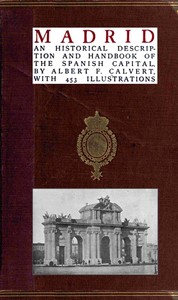
Madrid: an historical description and handbook of the Spanish capital — Story, Setting & Ideas can be approached with a clearer sense of reading commitment from its source measurements: 48,820 words, 3 hr 33 min estimated reading time, and 12 detected text sections.
The text analysis averages about 14.9 words per sentence, while the detected sections provide another way to judge how the source is divided.
Project Gutenberg metadata also associates the work with “Madrid (Spain) -- Description and travel,” connecting these edition facts with the source record’s subject description.
Explore this collection
These alternatives are selected using recorded categories and estimated reading time.
About 212 minutes
Geography
48,738 recorded words. 1 minutes difference from this book's estimate.
View Gutenberg source #69118About 197 minutes
Geography
45,088 recorded words. 16 minutes difference from this book's estimate.
View Gutenberg source #52885About 195 minutes
Geography
44,740 recorded words. 18 minutes difference from this book's estimate.
View Gutenberg source #54405Search stored excerpts and compare books → Choose by your preferences →
Choices use stored catalog measurements. Estimates vary with reading speed. A shared category is a catalog label, not a claim that two books have the same argument or literary quality.
Search reads excerpt text stored with this catalog and links to its associated Gutenberg record. The connection is stored in the site database; this tool does not recheck that every excerpt is word-for-word identical to that external record. Excerpt search does not cover every chapter and does not verify historical publication dates.
Catalog snapshot checked: 2026-09-26. Coverage: 100 public books, 100 available source excerpts.
Calculated from edition completeness, EPUB availability, text structure and catalogue metadata. Not a user rating.
Total of 100 points, scaled to a 2.5-5.0 range. Editions with an empty description or a missing EPUB file are not scored.
Public-domain source text
The source text is kept in the dedicated reader, separate from this catalogue record and its commentary.
Calvert opens by positioning Madrid as a latecomer among European capitals, noting that London was already important centuries before Madrid's first mention in 939. He traces the city's rise from a royal gout retreat under Charles V to its official status under Philip II in 1560, and defends it against critics who fault its climate and isolation. This defensive, corrective tone—aimed at dispelling 'erroneous and defamatory impressions'—sets up the handbook as both a travel guide and a rehabilitation of Madrid's reputation.
The preface establishes Madrid's peculiar origin: it became the capital not because of ancient prestige but because Charles V sought relief from gout in its 'brisk, rarefied air.' Calvert emphasizes this late start—Madrid is 'but a nursling among the cities of Spain'—and contrasts it with Toledo's Roman siege in the second century BC. This historical framing recurs throughout the excerpts, reminding readers that Madrid's architecture and collections were assembled relatively recently, often by royal decree. The city's official epithets—'Imperial y Coronada'—are presented as flattery rather than description, hinting at a gap between rhetoric and reality that the handbook aims to bridge.
A substantial portion of the excerpts describes the Royal Armoury in meticulous detail. Calvert moves from suit to suit, noting provenance, decoration, and historical associations: a suit made in Pamplona in 1620 for presentation to the Duke of Savoy; another with bullet indentations 'set with stones' that ironically prove the steel's weakness; tiny suits for boy princes, 'little more than a costly toy.' He connects objects to figures like the Infante Baltasar Carlos and Don Juan José, and to battles such as Ostend and Nieuport. The descriptions are precise—'blued and divided diagonally by foliations'—and often include evaluative asides, like the 'marvellous clearness' of an engraved gorget. This section reads as a curator's tour, blending technical observation with historical anecdote.
Beyond royal armour, Calvert highlights objects with legendary associations. A sword once thought to be the Cid's 'Colada' is now identified as St Ferdinand's 'Lobera'; a cloak and spurs of the sainted king are also displayed. He mentions the 'heavy weapon of Ferdinand the Catholic' and a sword inscribed with the Great Captain's name, as well as Pizarro's blade 'with which he won for Spain the vast empire of Peru.' A feather shield from Mexico depicts battles including Navas de Tolosa and Lepanto, made by indigenous artists under Spanish direction. These items shift the focus from courtly display to conquest and sanctity, suggesting that the armoury is also a repository of national myth. Calvert's tone remains descriptive but occasionally awed, as when he calls the feather shield 'an extraordinary example of what can be achieved with such apparently impracticable materials.'
Near the end of the excerpts, Calvert turns to the Visigothic crowns of Guarrazar, discovered in 1858 by peasants in a fountain bed. He notes their companions in the Cluny museum, linking Madrid's collection to broader European holdings. This brief mention hints at the handbook's scope: it covers not only the city's modern buildings and art but also archaeological finds that predate Madrid's capital status. The crowns, older than any armour described, serve as a reminder that Madrid's museums contain artifacts from Spain's deep past. Throughout the excerpts, Calvert balances historical narrative with practical description, a dual approach that defines the handbook's utility for a visitor seeking both context and detail.
Calvert's handbook rewards readers who move between its historical chapters and its detailed catalogues of art and armour. The excerpts show a writer deeply invested in correcting misconceptions about Madrid while providing concrete observations—the weight of a sword, the flexibility of a brigantine, the irony of perforated bullet marks. Readers should approach the text as a period piece that reflects early 20th-century attitudes toward empire and progress, but also as a reliable guide to the city's permanent collections.
Calvert mentions Madrid’s armoury, the stillness of old steel under glass. It took me back to a small village museum where my grandmother’s hand rested on my shoulder, her silence louder than any guidebook. That same quiet awe surfaced in An Englishwoman in the Philippines — Themes and Context, whose foreign rooms felt both strange and homey, just like that afternoon.
Your answers remain private and are stored only in this browser.









