
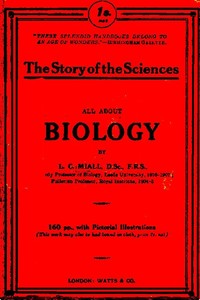
History of biology by L. C. Miall
First published over a century ago, L.C. Miall's 'History of Biology' is a guided tour through the ideas that built modern life science. It starts in the ancient world, where philosophers like Aristotle made brilliant guesses based on observation. From there, Miall walks us through the centuries, showing how each era built on—or argued against—the last.
The Story
The book doesn't have a single plot, but it has a clear narrative drive: the struggle for clarity. It shows how the invention of the microscope opened a hidden universe, changing everything. We see the long, slow death of the idea that life could spring from non-living matter (like maggots from meat), a belief that lasted for millennia. The story builds toward the unifying theories of the 18th and 19th centuries: classification systems that brought order to nature's chaos, the cell theory that revealed a common blueprint for all life, and finally, the revolutionary idea of evolution by natural selection. Miall presents these not as foregone conclusions, but as hard-won victories of evidence over tradition.
Why You Should Read It
What I love most is the human perspective. Miall, writing in the late 1800s, is close enough to these debates to make them feel urgent. He introduces you to the people—their arguments, their dead ends, and their flashes of insight. You get a real sense of how science actually progresses: not in a straight line, but in fits and starts, with plenty of wrong turns. Reading this old history today is fascinating because you know what comes next (like genetics and DNA), which Miall didn't. It gives you a unique appreciation for the foundation these earlier thinkers laid.
Final Verdict
This is a perfect read for curious minds who enjoy history or science, but aren't experts. It's for anyone who's ever looked at a tree or an animal and wondered, 'How did we figure all this out?' Because it's an older book, the language is formal in places, but the ideas are timeless and clearly explained. If you want a book that connects the dots from ancient philosophy to modern biology, showing the human drama behind our understanding of life itself, this is a wonderfully insightful place to start.
You are viewing a work that belongs to the global public domain. Knowledge should be free and accessible.
George Thomas
1 month agoImpressive quality for a digital edition.
Sarah Jackson
2 years agoI was skeptical about the depth of this book at first, but the quality of the diagrams and illustrations (if applicable) is top-notch. A solid investment for anyone's personal development.
Barbara Miller
1 year agoTo be perfectly clear, it challenges the reader's perspective in an intellectual way. A valuable addition to my collection.
Edward Ramirez
1 year agoAfter finishing this book, the arguments are well-supported by credible references. Thanks for sharing this review.

Ashley Moore
1 year agoAs a professional in this niche, the attention to detail regarding the core terminology is flawless. This has become my go-to guide for this specific topic.