
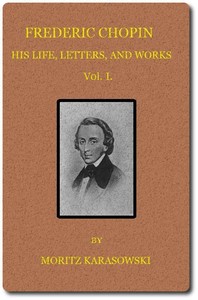
Frederic Chopin: His Life, Letters, and Works, v. 1 (of 2) by Maurycy Karasowski
Most biographies of Chopin start with the romantic figure in Paris, already ill and famous. Maurycy Karasowski's book does something different. He begins at the true beginning: a bright, musical boy in Warsaw, part of a loving, middle-class family. This first volume takes us from Chopin's childhood, through his formative years at the Warsaw Conservatory, right up to his permanent departure from Poland in 1830, on the eve of a devastating nationalist uprising.
The Story
This isn't a dry list of dates and compositions. Karasowski paints a vivid picture of young Fryderyk's world. We see his first piano lessons, his early public performances that stunned Warsaw, and his deep friendships. The heart of the story, though, is Poland itself. As Chopin grows into a young man, his country is under the oppressive thumb of the Russian Empire. The book shows how this political tension shaped him. His decision to leave for Vienna and later Paris wasn't just about career ambition; it was a painful exile. The volume ends with him abroad, hearing the news that the November Uprising has failed and his homeland is crushed. You're left feeling the weight he must have carried for the rest of his life.
Why You Should Read It
You should read this because it gives Chopin a spine. We often get the 'poet of the piano,' pale and suffering. Karasowski shows us the source of the storm and passion in the music: a clever, sometimes mischievous young man with a fierce love for his people and culture. Reading his personal letters, which are woven throughout, is the best part. You hear his witty voice, his worries about money, his sharp opinions on other musicians. It makes the genius feel real, grounded in a specific time and place. You start to hear the polonaises and mazurkas not just as beautiful pieces, but as coded messages of homesickness and defiance.
Final Verdict
This is perfect for classical music lovers who want to go beyond the concert program notes. It's also great for anyone who enjoys a compelling human story set against a backdrop of history and art. Be warned: it's an older biography (from the 1870s), so some details might be debated by modern scholars. But that's part of the charm—it's a primary source, written by someone who spoke to the people who knew Chopin best. Think of it as the foundational story, the essential first act to understanding the myth. Just be ready to dive into Volume 2 immediately after.
You are viewing a work that belongs to the global public domain. Thank you for supporting open literature.
Paul Hernandez
1 year agoCitation worthy content.
Karen Sanchez
1 year agoI started reading out of curiosity and it manages to explain difficult concepts in plain English. A valuable addition to my collection.


Richard Taylor
2 years agoSolid story.