
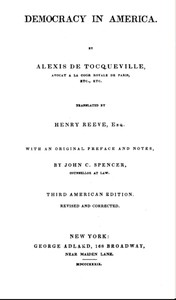
Democracy in America — Volume 1 by Alexis de Tocqueville
Forget what you think a 19th-century political science book should be. Democracy in America isn't a dry textbook. It's the travelogue of a sharp, 25-year-old French nobleman, Alexis de Tocqueville, who spent nine months journeying across the young United States. Officially, he was here to study our prison system. Unofficially, he was on a mission to figure out if this wild experiment in democracy could actually work, or if it would collapse into chaos.
The Story
There's no traditional plot with characters. The 'story' is America itself. Tocqueville acts as our guide, pointing out everything he finds fascinating and strange. He breaks down how our government is structured from townships up to the federal level. He observes our manners, our business hustle, and our non-stop political chatter. He's amazed by the 'equality of conditions'—the idea that no one is born superior here—and traces how that single principle shapes everything: our laws, our families, and even our literature. The central tension he explores is between our fierce individual freedom and the powerful force of majority opinion. He asks: In a society where the people rule, what protects the individual or the minority from the will of the crowd?
Why You Should Read It
You should read it because Tocqueville gets us. He identified the core American traits that still define us today. When he writes about our 'habits of the heart'—our pragmatism, our joiners' mentality, our suspicion of intellectual elites—it feels like he's describing your neighbors. His predictions are the most thrilling part. He foresaw the rise of the two-party system, the dominance of commerce, and America's future global power. But he also issued warnings that echo loudly now: about the 'tyranny of the majority,' the potential for materialism to hollow out civic life, and how centralized administration could grow quietly under a democratic guise. Reading him makes current events feel less like random chaos and more like chapters in a story he started telling long ago.
Final Verdict
This book is perfect for anyone curious about the roots of American culture, not just politics. It's for the person who watches the news and wonders, 'How did we get here?' It does require a bit more focus than a modern novel, but the payoff is immense. You won't agree with everything Tocqueville says (his views on race and Native Americans are very much of his time), but you'll be stunned by his clarity. Think of it as the ultimate 'user's manual' to the American experiment, written by its most perceptive early reviewer. Keep a highlighter handy—you'll need it.
There are no legal restrictions on this material. Knowledge should be free and accessible.
James Thomas
1 month agoA sophisticated analysis that fills a gap in the literature.
Nancy Garcia
1 year agoIt’s rare to find such a well-structured narrative nowadays, the narrative arc keeps the reader engaged while delivering factual content. A trustworthy resource that I'll keep in my digital library.
Betty Lopez
1 year agoPerfect.



Charles White
7 months agoGreat value and very well written.