
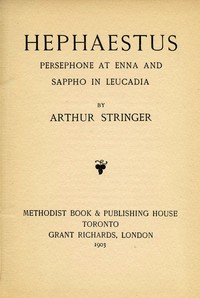
Hephaestus, Persephone at Enna, and Sappho in Leucadia by Arthur Stringer
Arthur Stringer's book is a triptych of poetic dramas, giving voice to three legendary figures in their quieter, more reflective moments. Forget the epic battles and grand romances; here, we catch them in the in-between spaces of their eternal lives.
The Story
In Hephaestus, we find the god of the forge alone. The fires are lit, but the great hall is empty. He crafts magnificent weapons for other gods, but wrestles with his own physical pain and a deep sense of being overlooked and unloved. It's a portrait of divine craftsmanship shadowed by isolation.
Persephone at Enna shows us the goddess during her six months above ground. She's back in the fields of her youth, but she's changed. The memory of the Underworld and her role as its queen clings to her, making the sunlight feel strange. She's caught between two worlds, belonging completely to neither, trying to reconcile the girl she was with the powerful figure she has become.
Finally, Sappho in Leucadia imagines the great poet in exile on the island of Leucas. An older woman, she looks out at the sea and back on a life filled with passionate loves, brilliant art, and piercing heartbreak. She sifts through her memories, weighing the joy of creation against the pain of loss and solitude.
Why You Should Read It
What grabbed me was how human these immortals feel. Stringer strips away their godly aura to explore the universal stuff: that ache of not fitting in, the weight of memory, and the quiet search for purpose. Hephaestus isn't just a smith; he's an artist wondering if his work matters. Persephone isn't just a seasonal symbol; she's someone trying to go home after a life-altering experience, only to find that 'home' doesn't fit anymore. Their struggles are surprisingly relatable. The language is poetic but clear, focusing on emotion and inner conflict rather than action.
Final Verdict
This book is perfect for anyone who loves mythology but craves a deeper, more personal look at the characters. It's for readers who enjoy thoughtful, character-driven stories over fast-paced plots. If you've ever wondered about the 'ever after' in 'happily ever after,' or if you appreciate beautiful, melancholic writing that sits with you, give this a try. It's a short, powerful collection that re-introduces you to figures you thought you knew.
This content is free to share and distribute. You are welcome to share this with anyone.
Linda Sanchez
4 months agoWithout a doubt, the flow of the text seems very fluid. I learned so much from this.
Anthony Nguyen
1 year agoThanks for the recommendation.
Ethan Torres
6 months agoI had low expectations initially, however it manages to explain difficult concepts in plain English. Exceeded all my expectations.
Emma Lewis
9 months agoWow.

Joshua Hill
1 year agoNot bad at all.