
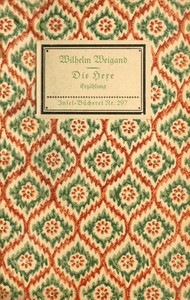
Die Hexe: Eine Erzählung by Wilhelm Weigand
Wilhelm Weigand's Die Hexe (The Witch) is a small book that casts a very long shadow. First published in 1893, it feels less like a relic and more like a sharp, clear window into human nature—a view that hasn't changed much at all.
The Story
We meet Anna, a woman in her late twenties who lives by herself in a cottage near a rural Bavarian village. She's not a classic outcast; she's capable, tends her garden, and minds her own business. But in a tight-knit, traditional community, her independence is itself a kind of provocation. The local men find her unsettling; the women find her suspicious. When a series of minor misfortunes befalls the village—a spoiled harvest, a sick animal—the need for a simple explanation takes over. Anna's differentness becomes the perfect target. The accusation of witchcraft isn't shouted from the rooftops at first. It starts with sidelong glances, then muttered words, then outright hostility. The story follows this terrifying snowball effect, showing how a collective lie can become a town's truth.
Why You Should Read It
What grabbed me wasn't any supernatural element, but the chilling realism. Weigand isn't writing about a medieval witch hunt; he's writing about a 19th-century one, which somehow makes it worse. The enemy isn't the devil—it's gossip, boredom, and the human need to blame someone. Anna is a fantastic character. She's not a saintly victim; she's proud and stubborn, which only fuels the fire against her. You feel her frustration and her slow, dawning horror as she realizes she can't reason her way out of this. The real horror is in the everyday details: a neighbor crossing the street to avoid her, a shopkeeper refusing her business. It’s a masterclass in building tension through social dynamics, not jump scares.
Final Verdict
This is a hidden gem for readers who love character-driven historical fiction with a dark, psychological edge. It's perfect if you enjoyed the creeping dread of Shirley Jackson's The Lottery or the exploration of mass hysteria in Arthur Miller's The Crucible. It's also a great, accessible pick for anyone curious about German literature from this period but wary of dense, philosophical tomes. Just be warned: it's a quiet, unsettling story that sticks with you, making you look at your own community a little differently. A powerful, concise punch of a book.
This text is dedicated to the public domain. Distribute this work to help spread literacy.
Robert Wilson
2 months agoThis was exactly the kind of deep dive I was searching for, the transition between theoretical knowledge and practical application is seamless. I'll be citing this in my upcoming project.
George Williams
1 year agoBefore I started my latest project, I read this and the author clearly has a deep mastery of the subject matter. Highly recommended for those seeking credible information.
Sarah Taylor
9 months agoUnlike many other resources I've purchased before, the attention to detail regarding the core terminology is flawless. Highly recommended for those seeking credible information.
Michael Davis
5 months agoExceptional clarity on a very complex subject.




Margaret Martinez
4 months agoBefore I started my latest project, I read this and the transition between theoretical knowledge and practical application is seamless. A rare gem in a sea of mediocre content.